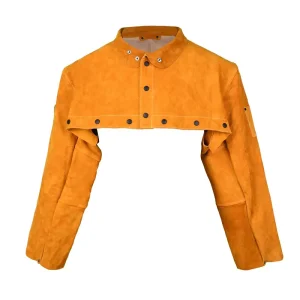
Explore our heavy-duty cowhide and flame-resistant industrial sleeves certified for continuous arc welding, cutting, and foundry slag environments.
A rigorous examination of transition mechanics from bulky heat apparel to modular, ergonomically calibrated composite protective sleeves.
In modern industrial fabrication, heavy metallurgy, and robotic manufacturing cells, protective arm sleeves have evolved from auxiliary accessories into mission-critical PPE components governed by stringent international life-safety standards. Historically, industrial operators were forced to rely on oversized full jackets even for overhead tack welding, minor maintenance grinding, and localized assembly tasks. This paradigm generated profound thermodynamic stress, reduced worker stamina, and increased non-compliance rates across high-ambient-temperature facilities.
Today, tier-1 procurement directors and environmental safety officers (EHS) mandate lightweight, modular solutions engineered to interface seamlessly with high-dexterity gloves and adjustable aprons. The contemporary market standard demands compliance with EN ISO 11611 (Classes 1 and 2 for protective clothing in welding processes), ASTM F1060 (conductive heat transfer), and NFPA 70E / ASTM F1506 (arc thermal performance). Addressing these requirements demands unprecedented control over fiber tensile retention, chromium tanning stability, and seam construction integrity under acute radiant exposure.
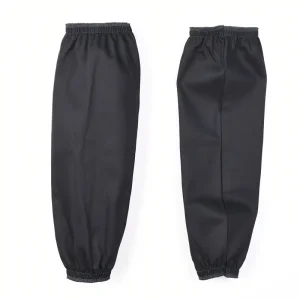
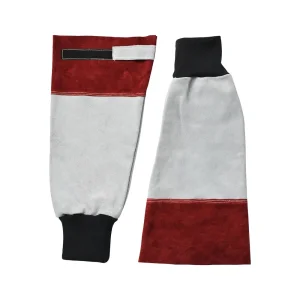
Engineered with specially graded 1.1mm - 1.4mm premium split cowhide and 9 oz flame-retardant treated cotton, withstanding spark impingement up to 1,000°C without melt-drop degradation or tensile failure.
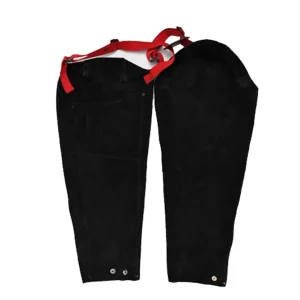
Anatomically contoured bicep configurations incorporating high-retention elastics, adjustable hook-and-loop closures, or leather suspension straps engineered to prevent slippage during overhead reach maneuvers.
By replacing heavy total-body garments with targeted sleeve assemblies for specific manufacturing cells, enterprise operations report up to a 34% drop in annual PPE expenditure and substantial reductions in heat-fatigue incidents.
Direct from Pukang Industrial Park, Gaozhou: Vertical integration from raw hide selection to final algorithmic carton nesting.
In contrast to intermediary trading organizations that outsource manufacturing to decentralized workshops, Guangdong Ming Shun Labour Protective Products Co., Ltd. operates on a deeply consolidated vertical infrastructure. Established over two decades ago in Gaozhou City, Guangdong Province, our facility maintains direct oversight over tanneries, chemical finishing matrices, automated hydraulic cutting lines, and dedicated stitching cells.
Our Factory 4.0 transformation integrates computerized leather flaw scanning, ensuring optimized yield ratios and uniform tensile density across every production batch. Furthermore, by retaining our own chemical dye vats and flame-retardant dipping troughs, we eliminate the 3-5 week dye-lot volatility common in fragmented supply chains. This structural efficiency translates to ironclad predictability for multinational contract orders, seasonal stock balancing, and custom OEM private-label deployments.
Digitally programmed laser and hydraulic die cutters maximize leather hide utilization while keeping grain alignment strictly parallel to forearm flex vectors.
Each production run undergoes seam rupture testing, snap torque pull audits (≥150N), and flame exposure verification before proceeding to custom packaging.
Full support for hot-stamped leather emblems, high-definition embroidery, custom wash care labels, barcodes, and drop-ship retail packaging design.
Located in strategic proximity to Guangzhou and Shenzhen maritime hubs, enabling expedited standard container loading and dynamic shipping schedules worldwide.
Direct material parameters to guide tier-1 safety directors in selecting proper arm PPE configurations.
| Material Configuration | Thermal & Flash Threshold | Mechanical Cut / Tear Resistance | Breathability Score | Ideal Industrial Setting |
|---|---|---|---|---|
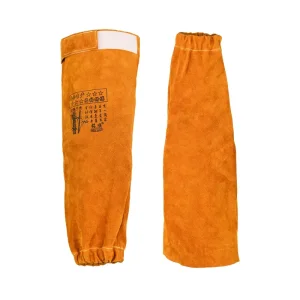
| Heavy Split Cowhide (1.2-1.4mm) | Extreme (Contact heat up to 350°C, Spatter immune) | EN 388 Level 4 Tear, Level 3 Abrasion | Low (Heavy thermal barrier) | Heavy FCAW/Stick Welding, Foundries, Shipyards |
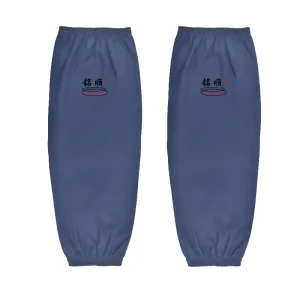
| FR Cotton (9 oz. Treated) | Moderate (Conforms to EN ISO 11611 Cl. 1) | Moderate Tear, Abrasion Resistant | High (Maximum all-shift airflow) | Light MIG/TIG, Automotive Body Assembly, Grinding |
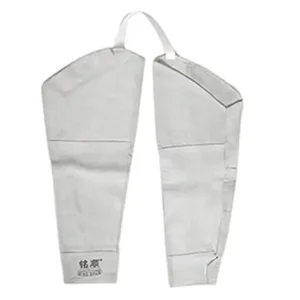
| Hybrid (FR Cotton Body + Cowhide Forearm) | High (Selective reinforcement on contact vector) | High on forearm, Balanced on upper arm | Balanced (Ergonomic venting) | Structural Steel Erection, Precision Metal Fab |
| Split Leather with Shoulder Harness | Extreme (Upper torso & total arm shield) | Industrial Heavy Duty | Moderate (Open chest design) | Overhead Positional Pipe Welding, Petrochemical Tanks |
Engineered for specialized exposure scenarios encountered in modern heavy fabrication and utility infrastructures.
Provides operators with agile protection against sharp sheet metal edges, robotic spatter bounce, and spot-welding thermal flashes without restricting forearm motion.
Withstands sustained, multi-hour flux-cored wire welding in confined bilge and double-bottom spaces where radiant reflection off bulkheads destroys conventional work shirts.
Used extensively in field pipeline spreads where all-weather overhead welding requires harness-secured leather sleeves to prevent slippage while protecting the brachial artery zone.
Facilitates precision preheated pipe root passes where continuous preheating coils maintain steel at 200°C+ and accidental forearm contact would cause catastrophic burns.
Engineered as an integral secondary barrier against radiant furnace wash and intermittent micro-droplets of non-ferrous molten splash during ladle transfers.
Critical considerations addressed directly by Ming Shun engineering and regulatory compliance directors.
Split cowhide provides an impermeable physical barrier against heavy molten slag and high-amperage spatter (exceeding 300A), delivering superior cut and abrasion resistance under harsh mechanical contact. In contrast, 9 oz. FR cotton is significantly lighter and breathable, engineered for warm climates or light-to-medium TIG/MIG processes where slag build-up is minimal and heat exhaustion is a high operational risk.
We conduct routine third-party and internal laboratory testing for tear strength (ISO 13937-2), flame spread (ISO 15025), dimensional stability, and impact of spatter drops (ISO 9150). Our leather split lots are audited for strict limits on Chromium VI, azo colorants, and pH balance, ensuring our partners receive complete technical compliance dossiers and test reports ready for notified body submission.
Our full-scope OEM capability includes customized sleeve lengths (standard 18", 21", or 23"), specialized wrist closures (elasticized knit cuff, cowhide strap with steel buckles, or hook-and-loop snaps), upper-arm tension straps, brand logo embossing, custom color dyes, and multi-language retail hangtags tailored to regional legal mandates.
Standard sample prototypes are completed within 5-7 business days from tech pack confirmation. Bulk container orders typically run on a 35 to 45-day production cycle, supported by our 1,000+ member workforce. Minimum Order Quantities (MOQ) start at 500 to 1,000 pairs depending on leather grade and specific custom hardware requirements.
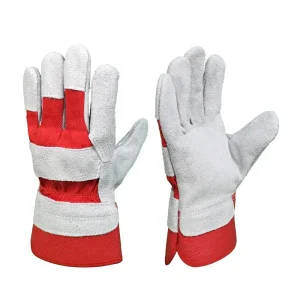
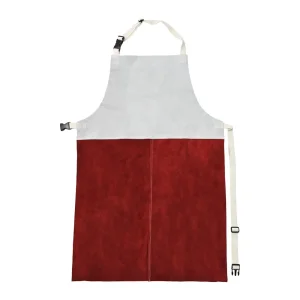
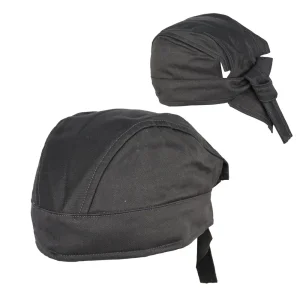
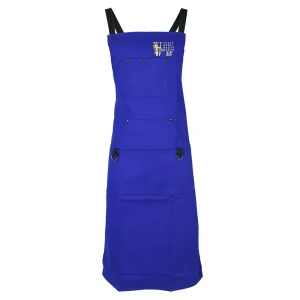
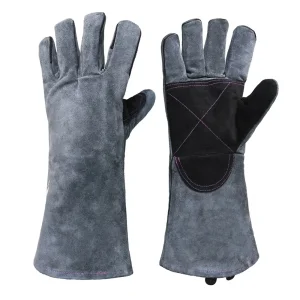
Complementary factory-direct protective equipment engineered to integrate with our sleeve lines for complete end-user compliance.