Explore high-heat welding jackets, hybrid cowhide apparel, and heavy spatter-resistant garments designed for foundry, shipyard, and offshore welding safety.
Located in the heart of Gaozhou, Guangdong—the world-renowned epicenter of leather tanning and PPE fabrication—our vertical manufacturing infrastructure eliminates trading markups and guarantees rigorous quality control.
We process raw cowhide, pigskin, and goatskin hides directly into finished split leather, paired with specialized FR chemical treatment lines (Proban & Pyrovatex technologies). Complete chain control lowers unit costs by 18-26% compared to regional re-sellers.
Every roll of 7oz, 9oz, and 11oz flame-retardant cotton and every square foot of A/AB-grade split cowhide undergoes tensile, tear, dimensional stability, and vertical flame testing inside our certified physical lab before garment paneling.
Operating over 25+ years with 1,000+ skilled sewing operators and computer-controlled leather cutting systems. Glove output exceeds 500,000 pairs monthly, and hybrid FR clothing output tops 120,000 sets per month with agile lead-time management.
Our CAD pattern engineering division translates European and North American tech packs into production-ready physical master garments within 5 to 7 days, complete with customized labeling, Kevlar® 3-ply stitching, and dielectric snap closures.
The protective clothing industry is evolving rapidly beyond archaic, heavy, monolithic leather aprons toward bio-engineered, lightweight hybrid textiles offering multi-risk defense.
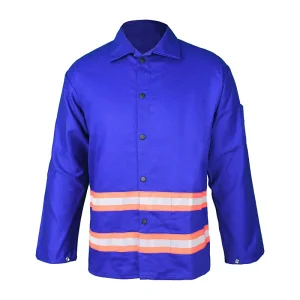
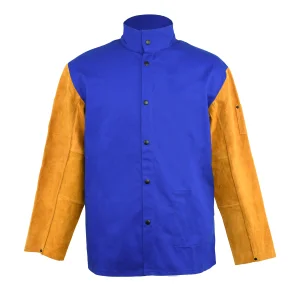
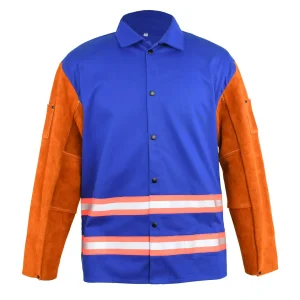
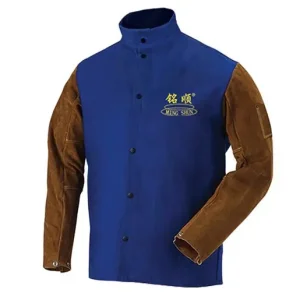
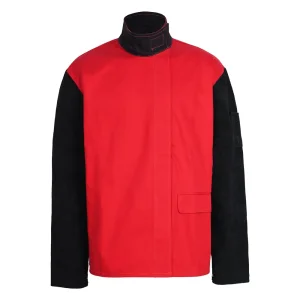
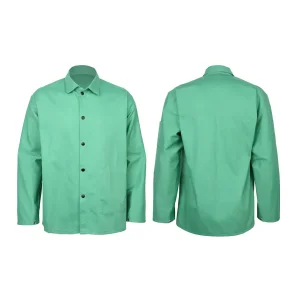
Traditional 100% all-cowhide welding jackets inflict severe user fatigue and heat stress during summer shifts. The global market is rapidly pivoting to Hybrid FR Cotton / Cowhide Jacketing. By deploying 9oz or 11oz breathable sateen FR cotton across the back, torso, and underarm zones while reinforcing the chest, shoulders, and forearms with 1.2mm premium split leather, workers gain 40% heat dissipation while sustaining Class 2 welding spatter protection.
Enterprises now mandate gear that satisfies both welding splatter standards (EN ISO 11611:2015) and Arc Flash electrical flashover thresholds (NFPA 70E, ASTM F1506, IEC 61482-2). Our proprietary double-treated FR cotton weaves provide verified Arc Thermal Performance Values (ATPV ≥ 9.2 to 14.0 cal/cm²), empowering maintenance workers to move seamlessly between welding torches and electrical panels.
Stricter ESG mandates from European and North American procurement groups necessitate Chromium VI-free and low-VOC leather. Ming Shun implements environmentally audited beamhouse and re-tanning procedures, eliminating hazardous azo dyes, formaldehyde, and heavy metals to ensure 100% compliance with EU REACH Regulations (EC 1907/2006).
Evaluate mechanical durability, thermal barrier efficiency, and weight profiles to match your project specifications.
| Protective Material | Grammage / Thickness | Spatter Resistance | Radiant Heat Protection | Breathability Score | Primary Regulatory Standard |
|---|---|---|---|---|---|
| Hybrid FR Cotton / Cowhide | 9oz Cotton + 1.2mm Split Leather | Very High (Class 2 Zones) | High (Up to 300°C Contact) | 8.5 / 10 (Ergonomic Core) | EN ISO 11611 Cl. 2, NFPA 2112 |
| Full Split Cowhide Leather | 1.2mm – 1.4mm Heavy Gauge | Maximum (Severe Molten Slag) | Maximum (Direct Flash & Spatter) | 3.0 / 10 (Heavy Barrier) | EN ISO 11611 Cl. 2, EN 388: 4244X |
| Premium 9oz FR Sateen Cotton | 305 g/m² 100% Cotton Weave | Moderate (Class 1 Light MIG/TIG) | Moderate (Short Radiant Bursts) | 9.5 / 10 (High Convection) | EN ISO 11611 Cl. 1, ASTM F1506 |
| Hi-Vis Flame-Resistant Twill | 10oz Cotton + Fluorescent Pigment | Moderate (Sparks & Grinding) | Moderate (Low Thermal Load) | 8.0 / 10 (High Visibility) | EN ISO 20471 Class 3, EN 11612 |
| Kevlar® Structural Stitching | Tex 80 / 100 3-Ply Para-Aramid | Immune to seam burn-through | Degradation above 450°C | N/A (Structural Seam Matrix) | ISO 13935-2 Tensile Proof |
Our FR Cotton/Leather protective garments and accessories are engineered to perform across punishing operational conditions globally.
Navigating confined double-bottom tanks and overhead bulkheads demands high mobility. Our MS-1260 and MS-287 hybrid jackets shield welders from ricocheting SMAW slag without trapping convective body heat in restricted compartments.
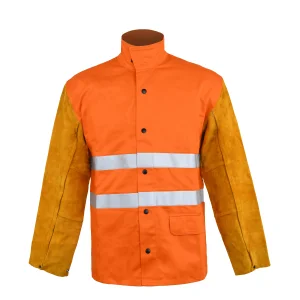
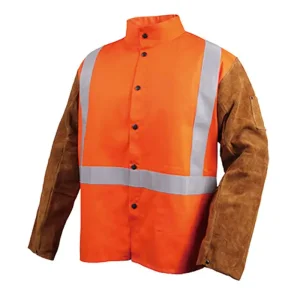
Corrosive marine air and combined hydrocarbons mandate dual-hazard NFPA 2112 flash-fire resistance and EN ISO 11611 hot-work protection. Leather-sleeve jackets with high-visibility reflective trim keep rig welders recognizable in low-light sea decks.
Robotic and manual MIG/GMAW spot welding cells require non-restrictive, spatter-proof garments. Split leather sleeves resist molten spatter adherence, shielding wrist flexors and radial arteries during rapid continuous seams.
Downhill cross-country pipeline welding entails intense high-amperage stick welding in direct contact with hot pipe walls. Our 30-inch leather/FR coats with Kevlar-reinforced stress gussets stop premature seam splitting.
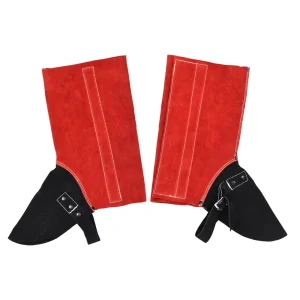
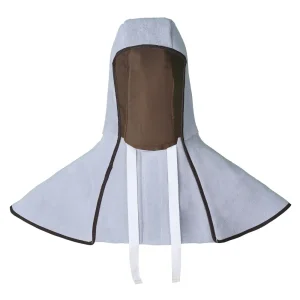
Pouring molten iron, aluminum handling, and oxy-fuel torch cutting emit sustained radiant heat. Complete split cowhide trousers (MS-270-1), leather hoods (MS-308N), and spats (MS-113) create an impenetrable secondary thermal barrier.
How global purchasing managers and procurement directors verify technical specifications, supply chain stability, and social compliance when sourcing directly from China.
B2B importers should insist on pre-production proof parameters prior to container dispatch:
Ming Shun supports distributors with end-to-end brand realization capabilities:
Essential insights for brand owners, safety equipment importers, and industrial supply distributors.
EN ISO 11611 categorizes welding protective apparel into two distinct threat tiers: Class 1 defends against less hazardous welding techniques and situations (e.g., TIG, micro-plasma, gas welding, resulting in lower spatter and drops < 15 drops of molten metal). Class 2 protects against severe, heavy spatter processes (e.g., MMAW stick welding, MAG, heavy FCAW, arc gouging, plasma cutting, requiring resistance to > 25 drops of molten metal and radiant heat transfer index RHTI 24 ≥ 16s). Our hybrid split cowhide and FR cotton gear is systematically calibrated to achieve Class 2 protection across high-exposure zones.
Chemically treated 100% cotton (such as high-grade Proban® or Pyrovatex® finishes) delivers superior breathability, exceptional skin comfort, and superior molten metal splash shed-off compared to synthetic blends, at approximately 40-50% lower raw material cost. While inherently flame-resistant aramids (Nomex/Kevlar) offer exceptional thermal threshold longevity, they tend to collect static and char immediately when impacted by heavy welding droplets. High-density 9oz – 11oz treated cotton sateen carbonizes smoothly without melting, making it the premier economic choice for welding apparel.
For custom private-label FR cotton/leather welding jackets, our standard MOQ is typically 300 to 500 units per style (flexible across common size runs from S to 5XL). For welding gloves and spats, MOQ begins at 1,200 pairs. Following initial tech pack alignment and physical counter-sample sign-off (completed in 5-7 business days), full container production is dispatched within 35 to 45 calendar days from our Gaozhou factory.
Our flame-retardant polymers are chemically bonded within the cellulose matrix of long-staple cotton fibers. We validate flame persistence through rigorous lab testing: test swatches undergo 50 commercial laundering cycles at 60°C (ISO 6330 6N) followed by vertical flame exposure testing (ISO 15025). The flame-retardant efficiency remains 100% active, preventing ignition or afterglow when laundering guidelines are adhered to (avoiding chlorine bleach and hydrogen peroxide oxidizers).
Yes. We furnish valid CE Type-Examination Certificates (Module B) and declaration of conformity under Regulation (EU) 2016/425 for European port clearance, as well as third-party NFPA 2112 / ASTM F1506 test reports issued by accredited international test houses (UL, SGS, SATRA, or Intertek). Each production lot is matched with a formal Certificate of Analysis (CoA) containing leather thickness, pH, tear resistance, and FR data.
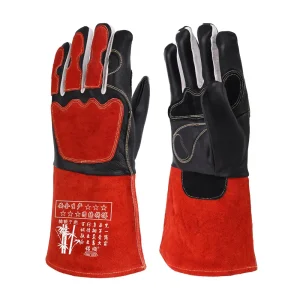
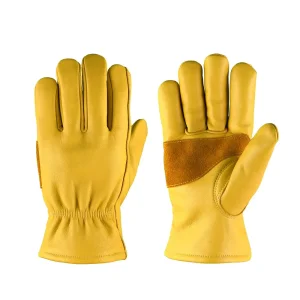
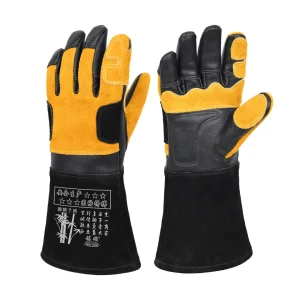
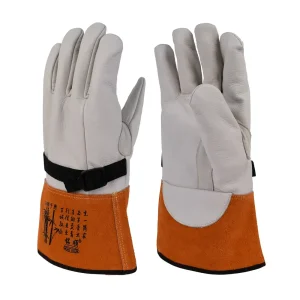
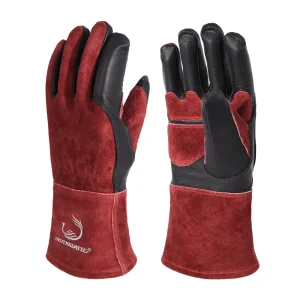
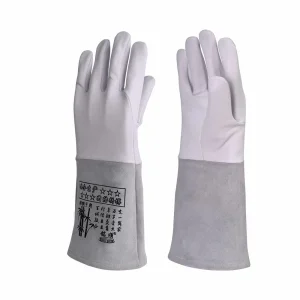
Complementary welding hand protection, goatskin TIG precision gloves, heavy MIG cowhide lines, electrician protectors, and spats manufactured under in-house leather tanning controls.