Global industrial engineering whitepaper and OEM manufacturing directory for high-durability split cowhide, flame-resistant hybrid textiles, and custom-tailored welding apron jacket solutions built for extreme molten splash protection.
Explore our core engineering catalog featuring split leather apron jackets, Kevlar-stitched sleeves, spats, and specialized thermal gloves manufactured in Gaozhou, Guangdong.
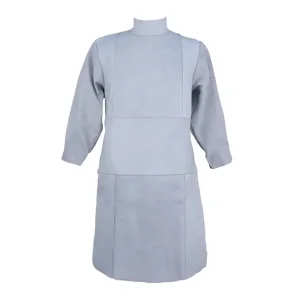
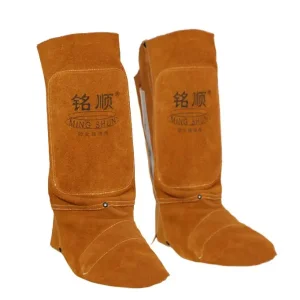
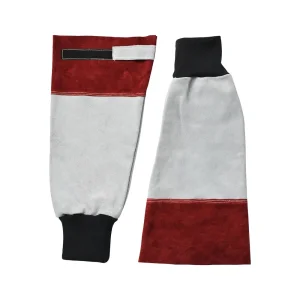
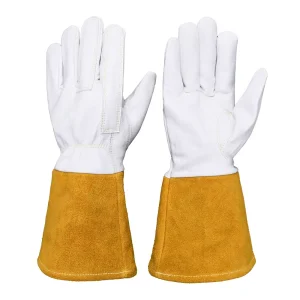
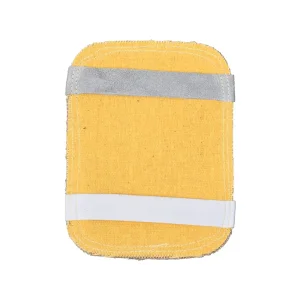
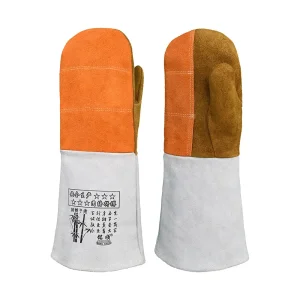
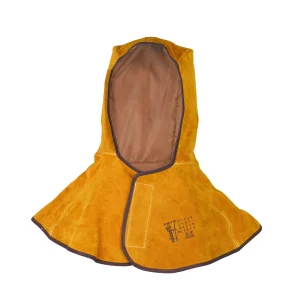
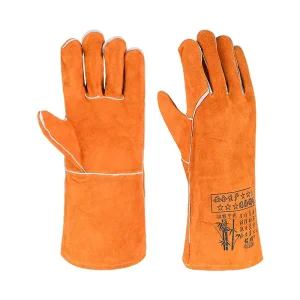
Vertical integration across leather processing, precision stamping, robotic pattern cutting, and manual assembly ensures repeatable quality across multi-thousand unit international deliveries.
In modern metallurgy and heavy structural manufacturing, welding personnel operate within close proximity to thermal radiation exceeding 1,600°C, hypervelocity spatter emissions, and toxic fumes. The hybrid welding apron jacket has emerged as the definitive personal protective garment across European shipyards, North American pipeline corridors, and automated Asian heavy machine plants. Unlike traditional static leather aprons or cumbersome monolithic leather jackets, the custom welding apron jacket merges the targeted ballistic protection of a chest-to-knee split leather apron with the 360-degree rotational mobility of articulating Kevlar-stitched sleeves and high-breathability flame-resistant (FR) back panels.
The performance envelope of an industrial apron jacket rests upon its leather hide selection. Guangdong Ming Shun Labour Protective Products Co., Ltd. controls raw hide intake directly at the tannery level in Gaozhou. Premium bovine leather undergoes secondary retanning with basic chromium salts or organic vegetable syntans to establish a dense collagen cross-linkage matrix:
| Component Zone | Material Specification | Thermal Threshold | Key Functional Objective |
|---|---|---|---|
| Front Bib & Lower Apron | Heavy Duty Grade-A Split Cowhide (1.3mm+) | Continuous radiant heat > 450°C | Deflect falling slag, molten spatter droplets, and sharp sheet metal edges. |
| Sleeve Assembly | Split Cowhide or Hybrid FR Cotton / Goatskin | Intermittent spatter > 350°C | Unrestricted elbow articulation; withstands slag dripping along torch arms. |
| Back Yoke & Underarms | Breathable Sateen Weave FR Cotton (9 oz - 12 oz) | Flame retardant flash > 260°C | Thermal vapor dispersion; mitigates heat-exhaustion during 10-hour shifts. |
| Reinforcement Points | Double-Layered Split Leather + Rivets | Impact / Shear Stress > 250 N | Prevents split seams at strap junctions, collar bases, and pocket gussets. |
Standard polymer or poly-cotton threads instantaneously disintegrate when exposed to red-hot molten globules. Ming Shun custom apron jackets utilize 3-ply and 4-ply 100% DuPont™ Kevlar® aramid threads possessing tensile break strengths exceeding 15 lbs per strand. All critical load-bearing seams implement double-lock welted stitches, embedding the stitch cavity beneath a recessed leather welt to physically isolate the aramid fibers from direct spatter abrasion. Furthermore, all stress terminals—such as shoulder harness junctions and bib-to-waist transitions—are mechanically anchored using dual-headed blackened dielectric brass rivets to eliminate electrocution hazards during arc gouging.
How our vertically consolidated manufacturing hub eliminates middleman arbitrage, mitigates raw material volatility, and accelerates global export velocity.
Located in Pukang Industrial Park, Gaozhou, our factory interfaces directly with domestic and international livestock processing chains. Raw cattle hides are selected, salted, limed, dehaired, and chrome-tanned in-house, ensuring 100% batch uniformity in leather thickness (0.1mm tolerance) and supple fiber density across seasonal fluctuations.
We operate specialized drumming machines capable of formulating bespoke pigmentations—such as Hi-Vis orange, charcoal graphite, rich golden yellow, and brand-specific PMS tones. All dye chemicals conform strictly to zero-AZO standards and maintain hexavalent chromium (Cr VI) levels below quantifiable limits (EPA 3060A / EN ISO 17075).
By bypassing third-party leather brokers, Ming Shun delivers an immediate 18% to 27% cost efficiency advantage to international private labels. Automated computerized nesting algorithms maximize leather hide surface yield, lowering waste margins and guaranteeing rock-solid unit pricing on multi-year contract tenders.
Ensure your protective clothing distribution programs remain legally compliant across European CE, British UKCA, and American OSHA/NFPA enforcement jurisdictions.
Protective clothing for welding and allied processes. Our jackets qualify for Class 2 (A1+A2), shielding against high spatter risks, heavy stick welding, and plasma cutting with radiant heat transfer indices (RHTI 24) exceeding regulatory thresholds.
North American standard on flame-resistant garments for industrial personnel. Evaluated via vertical flame tests (ASTM D6413), certifying char lengths under 4.0 inches and zero after-flame or melt-drip behavior when exposed to intense flash fire dynamics.
Federal general requirements for welding, cutting, and brazing apparel. Enforces complete torso, arm, and upper thigh coverage shielding workers from intense ultraviolet radiation, infrared flash, and secondary electrical shock occurrences.
Guaranteed free from restricted aromatic amines, pentachlorophenol (PCP), dimethyformamide (DMFu), and hazardous heavy metals. Leather materials adhere to strict European and Californian environmental contact thresholds.
Our rapid prototype lab accelerates product development lifecycles for private safety brands, EPC conglomerates, and safety distributors worldwide.
Our design team dissects your sizing tables (S through 6XL), seam tolerances, strap configurations (cross-back vs. neck-loop), and pocket placements for welding gauges and soapstone.
Laser cut patterns produce pre-production samples within 5-7 working days. Physical samples undergo dimensional checks, seam load verification, and wearer trial comfort assessments.
Integrate debossed leather insignia, embroidered flame-retardant arm patches, branded zinc snap buttons, woven satin compliance tags, and retail UPC display barcodes.
Pilot volume run (300-500 units) benchmarks line consistency. Destructive coupon testing validates aramid stitch tenacity, tear resistance, and anti-spatter drop resilience.
Moisture-barrier vacuum pack liners protect split leather from maritime humidity. Pre-palletized, barcoded cartons deliver seamless container load planning directly to your destination port.
Custom welding apron jackets engineered specifically to match the distinct spatter loads, duty cycles, and physical restrictions of global heavy industry.
Welders operating inside ballast tanks and double hulls encounter restricted horizontal movement and confined-space radiant thermal traps. Our hybrid split leather apron jackets with FR cotton shoulder bellows prevent neck chafing, deflect overhead slag drips, and allow rapid donning/doffing via quick-release magnetic harness buckles.
Robotic welding fixtures generate localized bursts of micro-fine spatter alongside sharp sheet metal burrs. Technicians maintaining high-speed MIG automation rely on custom-patterned apron jackets equipped with Kevlar sleeve liners to mitigate high-frequency laceration hazards without hindering arm agility.
Exposed high-altitude welding demands extreme windproof thermal integrity and abrasion toughness. Full-coverage 30-inch and 36-inch split leather bib aprons protect fall-arrest harness webbings from torch spark degradation, ensuring safety tie-offs remain certified throughout hot work activities.
The convergence of material nanotechnology, advanced ergonomics, and circular sustainability is redefining heavy PPE design for the next decade.
Traditional welding aprons suspend up to 2.5 kg of dense leather directly from the operator's cervical spine, precipitating chronic muscular strain. Ming Shun's next-gen designs utilize patented X-shaped cross-back self-balancing suspenders that redistribute static garment mass directly across the clavicle and pelvic core.
In anticipation of international restrictions on per- and polyfluoroalkyl substances, our R&D center is deploying organosilicon and bio-based dendrimer textile finishes that repel oils, anti-spatter chemical sprays, and industrial fluids without volatile organic emissions.
Embracing global ESG supply chain mandates, our facility offers titanium-syntan and synthetic aldehyde-tanned leathers. These non-chromium substrates deliver identical heat resistance ratings while producing zero hexavalent chromium byproduct risks during laser cutting or extreme arc exposure.
Prototyping sensor cavities within internal chest pockets allows insertion of RFID asset tracking tags, ambient temperature data loggers, and wearable biometric heat-stress monitors designed for harsh localized hot-work industrial environments.
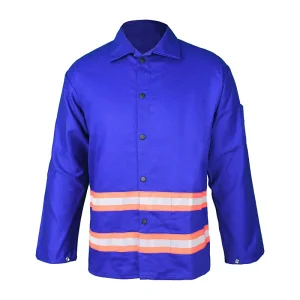
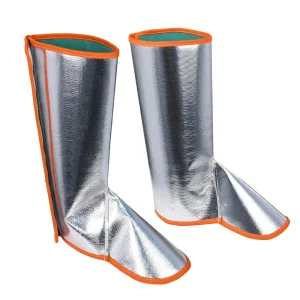
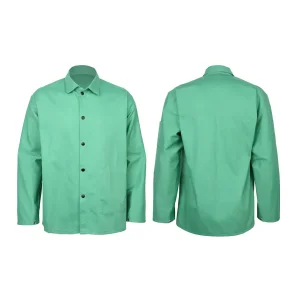
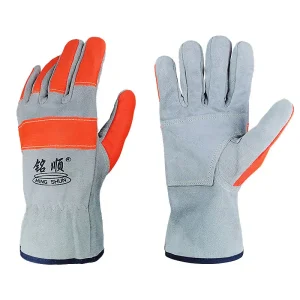
Complete your hot work equipment tender with Kevlar-stitched gloves, aluminized leggings, water-resistant cowhide garments, and FR cotton jackets.
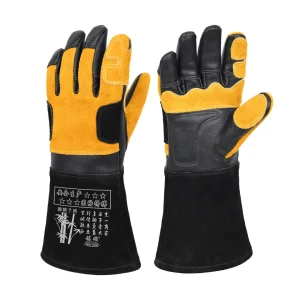
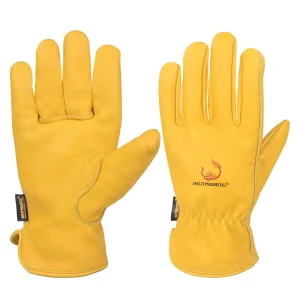
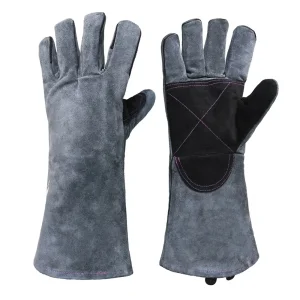
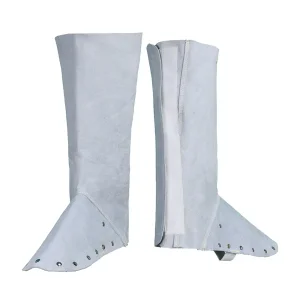
Direct answers for purchasing directors, supply chain leads, and PPE brand managers evaluating Ming Shun manufacturing capabilities.
A conventional full-leather welding jacket weighs between 2.2 kg and 3.0 kg, trapping core body heat and frequently causing occupational heat strain in non-ventilated indoor workshops. A hybrid welding apron jacket combines a heavy-duty 1.3mm split cowhide front bib with high-durability flame-resistant (FR) 9 oz or 12 oz breathable sateen cotton across the posterior shoulders, spine, and lower waist. This architecture preserves maximum front torso and arm protection against heavy molten metal spatter while cutting overall garment weight by up to 40% and exponentially accelerating convective air cooling.
EN ISO 11611 Class 2 compliance requires protective garments to withstand severe spatter impacts without seam separation or burn-through. Ming Shun strictly utilizes continuous filament 100% Para-Aramid (DuPont™ Kevlar® or equivalent) thread, typically sized at Tex 60 to Tex 80 with minimum loop tensile strengths of 45 N. The stitch geometry must maintain 3.0 to 3.5 stitches per centimeter (7-9 SPI) utilizing lockstitch (ISO 4915 Stitch Type 301). Furthermore, all external load-bearing joins must feature welted leather seam overlays to safeguard thread integrity against radiant flash erosion.
Yes. We regularly execute private-label OEM manufacturing based on client-furnished tech packs. Our computer-aided grading system accommodates standard European sizing (EN 340 / EN ISO 13688), North American sizing (Small through 6X-Large Tall with extended torso lengths and arm girth adjustments), as well as Asian industrial sizing metrics. We also customize bib coverage width, split-leg flap length, and cross-back strapping dimensions to ensure full ergonomic compatibility for your regional workforce.
For standardized factory leather shades (such as natural russet, golden yellow, dark chocolate, and industrial slate grey), our typical baseline order quantity is 300 to 500 units per style. For custom corporate pantone color matching of split leather and FR cotton canvas, MOQ is generally 1,000 units to support custom tannery drumming runs. Lead time for pre-production physical prototypes is 7 working days following CAD sign-off; full commercial container volumes (20ft/40ft HQ) are routinely manufactured, inspected, and dispatched within 35 to 45 calendar days.
Every batch of raw hide undergoes controlled drum tanning in our Pukang Industrial Park facilities utilizing European-formulated chemical agents free of restricted aromatic amines, Dimethyl Fumarate (DMFu), Nonylphenol Ethoxylates (NPEOs), and perfluorooctanoic acids. Leather splits are periodically submitted to accredited notified bodies (including SGS, TÜV, and CTC) for quantitative determination of Hexavalent Chromium [Cr(VI)] via EN ISO 17075-1 testing with detection limits under 3 mg/kg. Complete compliance documentation is supplied with pre-shipment quality dossier packages.
Guangdong Ming Shun Labour Protective Products Co., Ltd. is certified under ISO 9001:2015 for comprehensive Quality Management Systems and maintains a valid ISO 14001:2015 environmental certification. Our manufacturing facilities are fully qualified for BSCI (Business Social Compliance Initiative) and SMETA 4-Pillar social ethical audits, verifying fair labor conditions, occupational workplace safety protocols, absence of child/forced labor, and transparent corporate governance.

