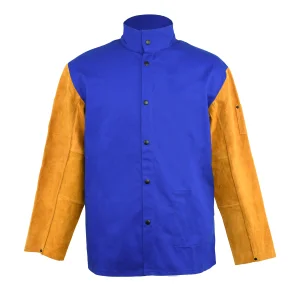
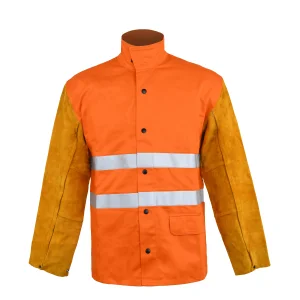
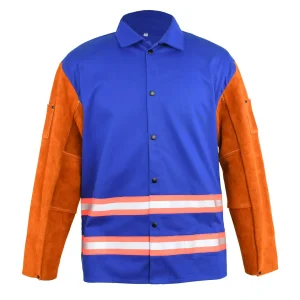
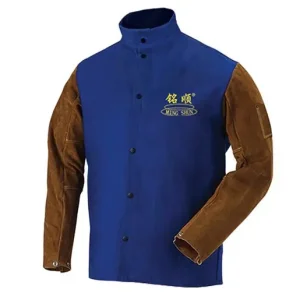
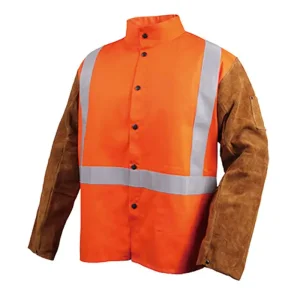
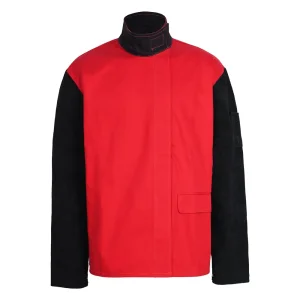
Pre-configured hybrid leather and heavy FR cotton garments integrated with welding helmet bib seal points, rigorously stress-tested for continuous overhead stick and high-amperage MIG hot work.
Understanding the severe environmental constraints and thermal performance thresholds required by the Puget Sound industrial belt.
In maritime repair and ship hull construction, welders frequently operate in confined double-bottom tanks, vertical pipe tunnels, and overhead bilge compartments. In these tight, acoustically intense, and poorly ventilated environments, welding arcs generate radiant heat exceeding 5,000°F alongside a continuous bombardment of molten metal spatter, superheated flux flakes, and ultraviolet radiation. The junction between the welder’s face shield or autodarkening filter (ADF) helmet and their protective chest jacket is consistently recognized as the primary safety hazard zone.
Standard welding hoods leave a dangerous anatomical gap around the anterior throat, thyroid cartilage, and lateral cervical triangles when an operator tilts their head backward for overhead SMAW (stick) or FCAW (flux-cored) welding. Without a dedicated, heavy-duty helmet bib, this open threshold funnels red-hot molten slag directly onto the collarbones, burning through cotton undershirts and causing severe cutaneous burns, sudden welder twitch reactions, and hazardous dropped-tool accidents in aloft rigging.
Simultaneously, Seattle's expansive aerospace manufacturing and specialized tooling supply chain enforce extreme particulate-free hot-work conditions. Precision tungsten inert gas (TIG) and electron beam welding stations require protective helmet bibs and FR garments that offer zero particulate shedding, non-combustible fiber stability, and absolute optical reflection dampening to protect against secondary arc bounce off polished aluminum and titanium structures.
Moisture accumulation from Seattle’s ambient 75%+ relative humidity drastically reduces the dielectric resistance of saturated standard fabrics. Our factory engineers helmet bibs and hybrid FR garments utilizing hydrophobic split cowhide and chemically passivated FR cotton that resist dampness absorption, preventing arc tracking and electrical pin-hole burn conduction.
How scientific material blending bridges the historical tradeoff between rigid thermal barrier protection and physiological mobility in cold-weather maritime environments.
Sourced exclusively from premium dense-grain bovine hides, our split leather undergoes proprietary chrome tanning and fat-liquoring processes to eliminate stiffness while maintaining a flame penetration point surpassing 800°C. Resists puncture from razor-sharp slag and direct mechanical shear during structural pipe beveling.
Unlike topically dipped textiles that wash out in commercial laundry cycles, our high-density sateen weave cotton utilizes reactive organophosphorus chemistry that polymerizes deep within the cellulose core. Upon arc flame impingement, the fabric chars instantly without melting, afterglow, or synthetic molten dripping.
All critical high-impact zones, bib anchor rims, and sleeve hinges are triple-lock stitched with 100% genuine DuPont™ Kevlar® para-aramid thread. Inherently non-flammable up to 900°F, preventing catastrophic seam bursting and thermal separation under intense cyclical stress and UV flash exposure.
Full regulatory cross-validation to ensure procurement agents, safety engineers, and risk officers remain entirely insulated against non-compliance liabilities.
| Regulatory Standard | Governing Body / Jurisdiction | Critical Engineering Metric Tested | Ming Shun Factory Attainment |
|---|---|---|---|
| ANSI/ISEA Z49.1 | American Welding Society / National | Radiation leakage, helmet interface gap coverage, neck spatter deflection | Certified 100% zero-gap integration with universal helmet cowls |
| WAC 296-24-68001 | WA Dept of Labor & Industries (DOSH) | Flame resistance of hot-work PPE in confined industrial spaces | Surpasses char length < 4.0 inches, zero melt-drip duration |
| ASTM F1506 / NFPA 70E | ASTM International / NFPA | Electric Arc Exposure & Arc Thermal Performance Value (ATPV) | ATPV ratings from 9.2 cal/cm² (HRC 2) up to 34 cal/cm² (HRC 3) |
| ASTM F955 | Heavy Industry Metallurgy Council | Molten metal splash and thermal transfer index through layered textiles | Molten iron & aluminum drop resistance without back-side scorch transfer |
| EN ISO 11611:2015 | International Standard Organization | Class 1 & Class 2 welding protective clothing against spatter & radiant heat | Class 2 (A1+A2) full certification on all split leather hybrid series |
Every single helmet bib and FR cotton/leather garment batch leaving our factory floor is backed by traceable lab test reports, including lot-specific flame spread testing (ASTM D6413 vertical flame) and leather tensile shear certifications. For large-scale Seattle contracts, including municipal ferry maintenance and naval dockyard overhauls, full submittal packages are prepared directly by our compliance engineering department.
Bypassing multi-tier distribution markup to secure stable factory lead times, custom brand identification, and volume-scaled cost efficiencies.
Commercial safety PPE programs frequently suffer from hidden budget drain caused by rapid garment replacement. When low-tier welding bibs or jackets utilize split cowhide derived from low-density belly cuts or cotton treated with transient chemical sprays, the gear degrades after fewer than 10 industrial wash cycles or fails catastrophically under heavy flux-cored spatter.
By manufacturing directly with Grade-A bovine shoulder cuts and vat-polymerized FR cotton, Ming Shun garments deliver more than 300% longer operational field life across Northwest shipyard environments. This dramatic durability reduction drives down your client’s annualized cost-per-welder ratio, providing distributors with an unassailable commercial sales proposition.
We partner with safety equipment wholesalers, regional welding supply stores, and multinational safety brands across Washington State. Our OEM capabilities encompass:
Request an itemized wholesale tier sheet, custom OEM spec sheet, or pre-production sample pack delivered directly to your Seattle or regional distribution center.
How automated computer-vision leather inspection, nanotechnology FR treatments, and ergonomic sensor integration are redefining welder defense systems.
Eliminating structural weak points caused by conventional die stamping, our facility uses high-precision multi-axis CO2 laser tables. Leather edges are heat-cauterized during the cutting process, preventing fringe unravelling and seam distortion over prolonged marine hot-work exposure.
With Powered Air-Purifying Respirators (PAPR) becoming standard in Seattle shipyards to meet OSHA hexavalent chromium limits, our 2025+ helmet bib patterns feature micro-baffled perimeter skirts that block spatter while permitting laminar clean-air exhaust without inflating the hood.
Currently in advanced prototyping: ultra-thin graphene-enhanced internal linings that dissipate concentrated radiant heat 400% faster than standard foam padding, preventing neck surface hotspot development even when welding 600-amp submerged arc or high-duty pulse spray processes.
In-depth responses covering technical specifications, MOQ requirements, international logistics, and regulatory compliance.
When welders work in the 4G (overhead plate) or 6G (inclined pipe) positions characteristic of Seattle shipyard and structural ironwork, turning up an FR jacket collar only protects the neck up to the lower jawline. As the head pitches back to track the puddle, the cervical area is stretched and completely exposed beneath the lower rim of the welding helmet. A securely clamped helmet bib moves synchronously with the welder's head, creating a constant, overlapping shingle effect that sheds falling slag and blocks upward-bouncing spatter from entering the helmet cavity or burning the neck.
Our factory manufactures three universal attachment architectures engineered to fit major brands utilized across the Pacific Northwest (including Lincoln Electric Viking™, Miller Digital Infinity™, 3M Speedglas 9100™, and Fibre-Metal Tigerhood™): (1) high-heat flame-retardant hook-and-loop strips with military-grade 3M adhesive backing, (2) push-fit high-tension spring-steel edge clips that seat directly over standard fiberglass/nylon cowl lips, and (3) heavy-duty molded silicone retention bands that wrap securely around the chin guard. Custom mounting configurations can be tailored for OEM runs.
Standard wholesale production for custom OEM orders averages 30 to 45 business days post-sample approval. For ocean freight, direct container lines operating from South China/Guangdong to the Northwest Seaport Alliance (Seattle/Tacoma) offer industry-leading transit times averaging only 14 to 18 days on the water. Express air-cargo consignment is also supported for rapid restocking of high-demand sizes or emergency shipyard project deadlines.
Unlike trading intermediaries who purchase irregular leather remnants on the open spot market, Ming Shun maintains dedicated in-house leather sorting, tanning, and dyeing operations. Every hide is inspected for thickness consistency (1.2mm–1.4mm caliper), uniform tensile density, and moisture balance. All batches undergo strict vertical flame testing (ASTM D6413) to ensure zero open-flame persistence and no chrome leaching, ensuring the 10th container matches the exact texture, weight, and protective rating of the initial approval sample.
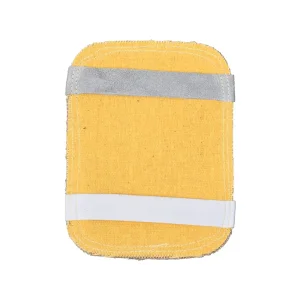
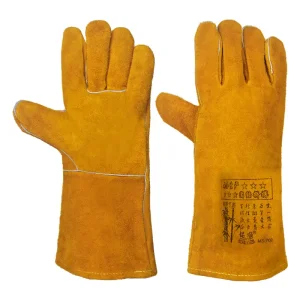
Explore our integrated wholesale range of heavy-duty welding spats, thermal back hand pads, spark containment blankets, and hybrid safety jackets engineered for extreme Pacific Northwest industrial duty.
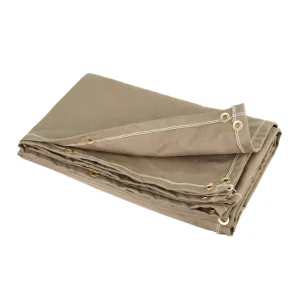
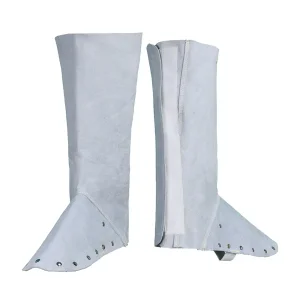
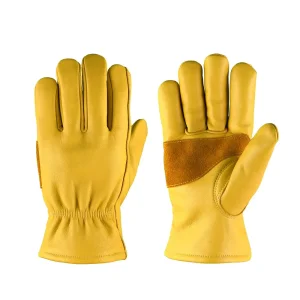
Whether outfitting an entire commercial shipyard facility in Elliott Bay or distributing private-label helmet bib accessories across Washington, Oregon, and Alaska, our sales engineering division is ready to assist.
Send Inquiry Now
