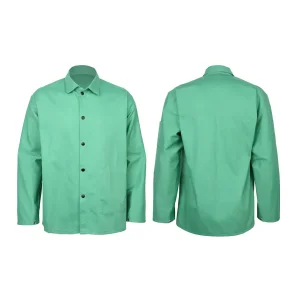
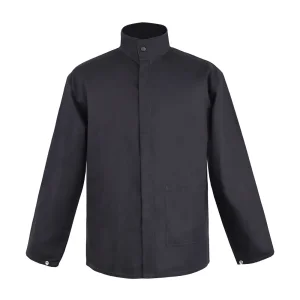
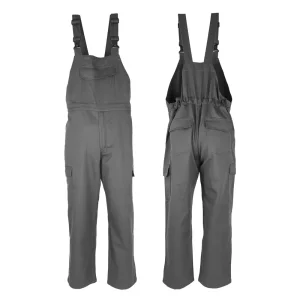
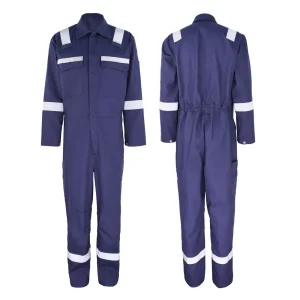
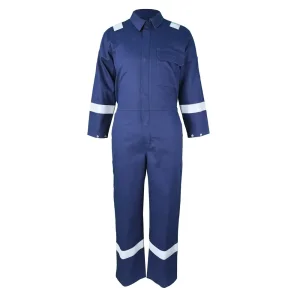
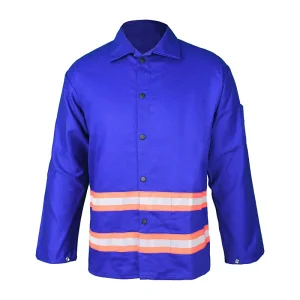
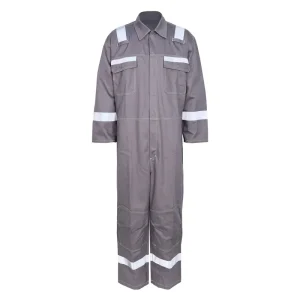
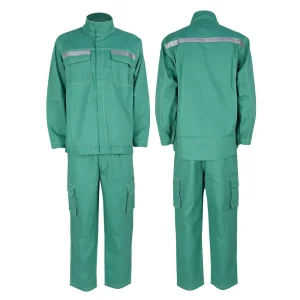
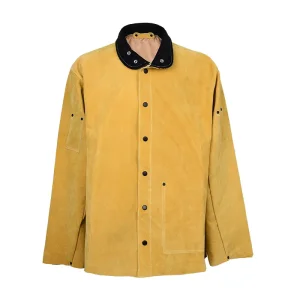
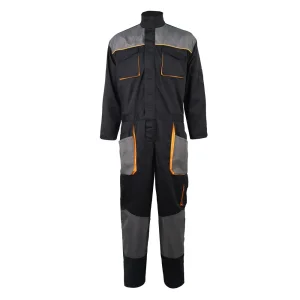
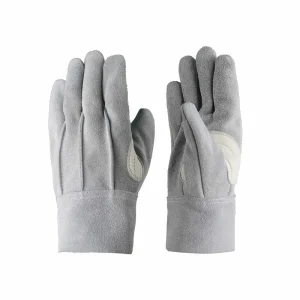
Engineered for high-spatter MMA/MIG operations across Gauteng manufacturing corridors and Richards Bay heavy fabricators.
A rigorous examination of thermo-mechanical protection, SABS adherence, and heat-stress management in African heavy industries.
The procurement ecosystem for Flame-Resistant (FR) welding jackets and secondary thermal protective wear in South Africa is defined by a rigorous triad of challenges: stringent regulatory enforcement under the Mine Health and Safety Act 29 of 1996 (MHSA), an escalating focus on the South African Bureau of Standards (SABS / SANS 434 & SANS 1423-1), and extreme ambient thermal profiles. Across the gold, platinum, and coal mining belts spanning Gauteng, Mpumalanga, Limpopo, and North West province, industrial hot-work takes place in confined spaces characterized by elevated humidity, airborne particulate loads, and ambient temperatures exceeding 38°C.
Traditional, heavy chrome-tanned full-leather cowhide jackets, while offering impenetrable barrier resistance against severe spatter, frequently trigger worker non-compliance and debilitating heat-stroke risks in such subterranean and structural environments. Consequently, tier-one fabrication contractors, engineering procurement management (EPCM) entities, and state-owned enterprises (such as Transnet and Eskom) are rapidly migrating toward hybrid thermodynamic protective jackets—utilizing chemically treated or inherently flame-resistant breathable cotton torsos (300 to 350 GSM) supplemented with grade-A split leather sleeves and high-stress Kevlar® seam shielding.
Compliance requires verifiable certification: non-conductive concealed stud closures, zero synthetic core exposure, zero drop-through slag absorption, and electrostatic dissipative (ESD) compliance for high-methane coal and petrochemical installations (Sasolburg & Secunda).
By engineering specialized open-weave 9 oz and 10.5 oz cotton treated via advanced ammonia-cure polymer finishing (THPC), our protective jackets enable trans-epidermal heat dissipation, minimizing heart-rate acceleration in unventilated structural welding cells.
Navigating maritime logistics bottlenecks at Durban and Cape Town ports requires predictable containerized batch manufacturing, custom barcoding, localized metric sizing (S to 5XL), and pre-shipment SGS/Intertek batch quality verifications.
Transitioning from basic thermal barriers to smart, sustainable, circular-economy industrial garments.
The global welding apparel industry is undergoing a structural paradigm shift driven by stringent decarbonization directives, multi-hazard integration, and advanced textile chemistry. Historically, personal protective equipment (PPE) manufacturers operated within rigid product silos: leather dominated molten-metal droplet deflection, while flame-retardant treated cotton (FRC) satisfied lighter radiant-heat requirements. Today, leading industrial centers in Europe, North America, and emerging industrial nodes across South Africa demand multi-norm harmonization—where a single jacket satisfies molten metal spatter deflection (EN ISO 11611 Class 1/2), convective/radiant heat resistance (EN ISO 11612 A, B, C, E), electric arc thermal protection (IEC 61482-2), and high-visibility luminescence (EN ISO 20471 / SANS 50471).
Phasing out fluorochemicals in favor of bio-based silicone cross-linking finishes that reject oil, water, and acidic industrial slurries without compromising flame quench rates.
Integrating pre-curved sleeves, gusseted underarms, and bi-swing action backs to eliminate jacket pull-up during continuous overhead pipe welding and rig fabrication.
Integrating passive RFID and thermo-chromic visual alert threads that notify safety managers when the fabric substrate has absorbed cumulative degradation heat thresholds.
Establishing collection and reclamation pathways for end-of-life cotton and leather welding jackets to re-spin aramid cores and extract natural fibers for secondary thermal soundproofing.
Engineered to mitigate specific thermal and mechanical failure points across southern African operational clusters.
Underground structural rail rehabilitation and mill liner repairs where excessive heat, ambient dampness, and restricted ventilation demand breathable 9 oz FR jackets with dielectric anti-arc snaps.
Maintenance turnaround operations in high volatile hydrocarbon zones requiring dual-certified Antistatic Arc/FR outerwear that prevents static discharge sparks in classified explosive gas environments.
Submerged arc and high-amp flux-cored welding operations on marine hulls and rolling stock. Demands cowhide hybrid configurations resisting aggressive maritime salinity, continuous high-flux slag, and UV radiation.
Direct manufacturer supply for distributors, mining procurement desks, and private-label PPE houses.
Direct technical answers regarding import protocols, wash cycles, and material composition.