Engineered for high-duty cycle automotive robotic touch-up, structural arc welding, and specialized tooling environments across the Chukyo Industrial Corridor.
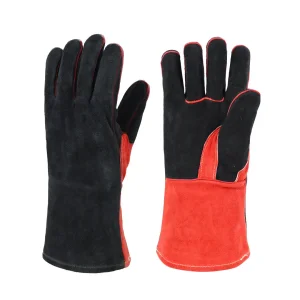
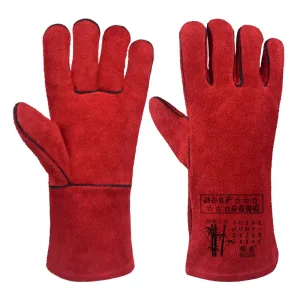
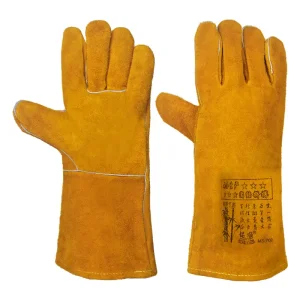
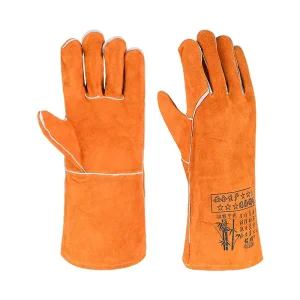
Analyzing the intersection of automotive assembly, aerospace component machining, and structural metal fabrication throughout Aichi Prefecture.
The Greater Nagoya region, anchoring the vibrant Chukyo Industrial Area, represents the undisputed manufacturing heartbeat of Japan. Accounting for over 14% of the country’s total industrial shipments annually, Nagoya’s economic corridor is fueled by the world's most sophisticated automotive supply clusters centered around Toyota City, Kariya, and Okazaki, alongside an internationally acclaimed aerospace engineering ecosystem spanning Komaki, Ooe, and Minato Ward.
In this demanding industrial paradigm, manual and semi-automated welding are not merely metal-joining steps; they are critical quality-gate processes. From precision body-in-white (BIW) robotic weld touch-ups to high-tolerance titanium ducting for commercial aerospace assemblies, welders operate under exacting zero-defect philosophies (Poka-Yoke) and lean Just-In-Time (JIT) cycles.
Traditional, commodity-grade personal protective equipment (PPE) consistently fails to meet these rigorous parameters. Local operations demand custom welding gloves that guarantee extreme tactile sensitivity for micro-TIG filler feeding, high-amperage spatter resilience, and total compliance with JIS T 8116 standards, while maintaining ergonomic endurance across 8-hour production shifts.
| Chukyo Industrial Sector | Primary Joining Process | Critical PPE Glove Attributes |
|---|---|---|
| Automotive OEM & Tier 1 | Resistance Spot Touch-up, GMAW/MIG | High seam tensile strength, Kevlar welted seams, radiant heat shielding |
| Aerospace Structure | GTAW/TIG, Orbital Plasma | Fingertip sensitivity, premium grain goatskin, zero chrome bloom |
| Rolling Stock & Heavy Mach. | Submerged Arc, Heavy SMAW | 1.3mm+ split cowhide, fleece insulating liner, extended gauntlet cuff |
| Nagoya Port Maritime | FCAW Flux-Cored, Flame Gouging | Hydrophobic leather finish, molten slag shedding, EN 388 Level 4 abrasion |
How direct-from-source manufacturing infrastructure resolves raw leather volatility, quality variance, and import bottlenecks.
We eliminate trading middleman markups by managing raw leather tanning, grade segregation, and chromium-safe processing in-house. Split cowhide is rigorously calibrated between 1.2mm and 1.4mm thickness, ensuring identical thermal retention batch after batch.
Our glove prototypes undergo independent laboratory mechanical (EN 388) and thermal (EN 407) validations. Japanese customers receive dual-certified documentation, ensuring seamless compliance audits by labor safety inspectors in Japan.
Positioned along optimal shipping routes to the Port of Nagoya—Japan's primary cargo gateway handling roughly 10% of total maritime trade—we guarantee efficient containerized maritime transport and expedited consolidation services.
Specific protective configurations engineered to withstand high-stress shop-floor realities across Aichi Prefecture industrial districts.
Operators clearing spatter buildup or conducting offline MIG repairs require rapid heat dissipation and cut-resistant palms. Reinforced thumbs and welted aramid seams prevent burn-through from continuous localized spatter bursts.
Manual TIG welding of Inconel and Grade 5 titanium components necessitates unmatched dexterity. Soft-tanned goatskin gloves with seamless index-finger design permit flawless wire feeding and torch micro-adjustments.
Thick plate flux-cored arc welding generates sustained radiative heat. High-density split cowhide gloves lined with laminated flame-retardant cotton provide 350°C contact heat protection up to 15 seconds without stiffening.
Pioneering sustainable leather tanning, ergonomic biomechanics, and integrated workplace telemetry for tomorrow’s smart factories.
Adopting advanced aldehyde and synthetic bio-tanning to completely eliminate hexavalent chromium formation during extreme thermal weld cycles.
Anatomically pre-curved finger construction engineered from 3D hand scan datasets reduces hand fatigue during repetitive gripping by 28%.
Nano-silica coatings integrated into split leather fibers repel industrial cutting fluids, stamping lubricants, and molten flux residues.
Collaborative research integrating passive RFID and thermal threshold indicators to alert workers prior to conductive thermal breakdown.
In-depth technical clarifications covering testing standards, custom private labeling, MOQ thresholds, and Japanese logistics.
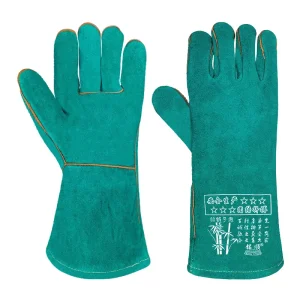
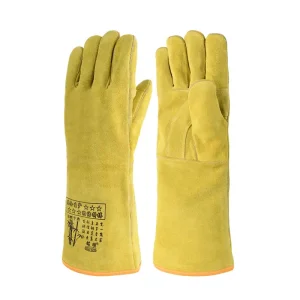
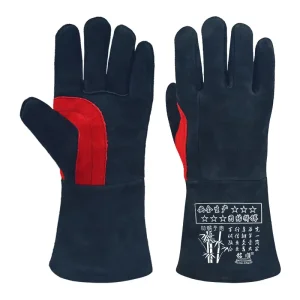
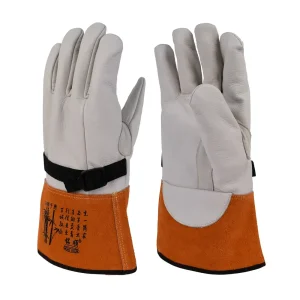
Engineered for extreme duty cycles, continuous flux-cored arc welding, and specialized high-voltage maintenance across Japan's industrial centers.
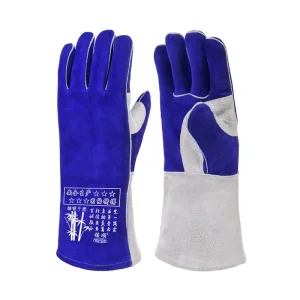
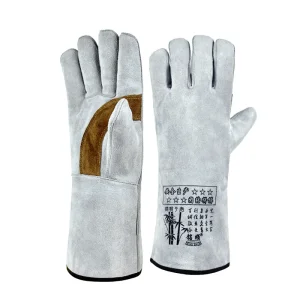
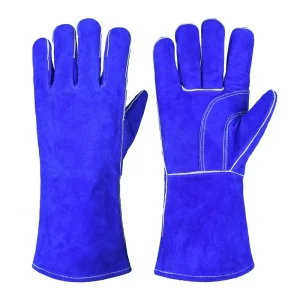
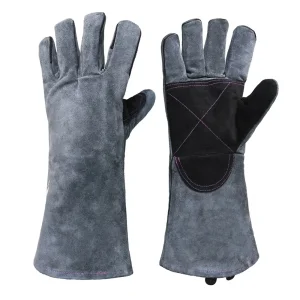
Partner directly with an established high-capacity manufacturer. Benefit from custom leather tooling, strict JIS T 8116 quality compliance, and direct shipping pipelines to the Port of Nagoya.