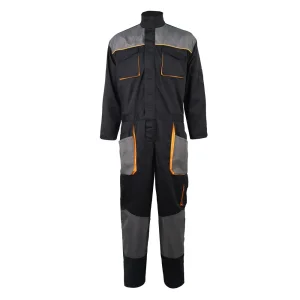
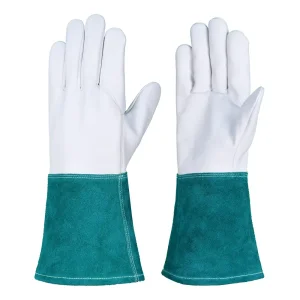
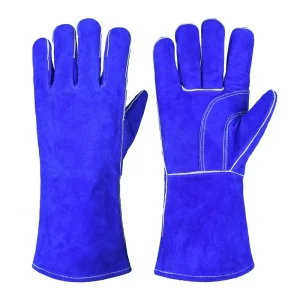
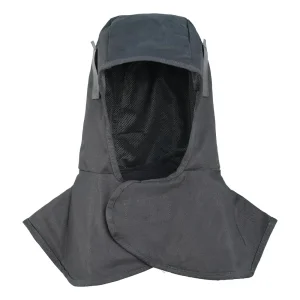
Engineered for high-spatter MIG, stick, and heavy metallurgical environments. Explore industrial configurations.
An authoritative analysis of regulatory enforcement, raw material volatility, and heavy manufacturing evolution.
Global welding protection has migrated from discretionary gear to non-negotiable statutory compliance. Importers in North America (OSHA, ANSI/ISEA 105) and the European Union (EN ISO 11611, EN 12477) require unbroken audit trails, verified burn-through latency ratings, and certified seam tensile strengths to mitigate catastrophic enterprise liability.
Brokers and intermediary sourcing models are collapsing due to margin compressions and unpredictable defect rates. Modern safety distributors favor Tier-1 primary manufacturers capable of vertically integrated hide tanning, automated CAD cutting, in-line FR polymer coating, and verifiable QA batch traceability under single-roof governance.
Industrial health and safety directors now analyze lifecycle durability over unit acquisition costs. Premature seam destruction from thermal spatter and leather stiffening cause operational downtime. High-grade cowhide, Kevlar thread integrity, and breathable split/cotton balances extend field lifespans by up to 280%.
Bridging heavy thermal protection with biomechanical performance and chemical flame resistance.
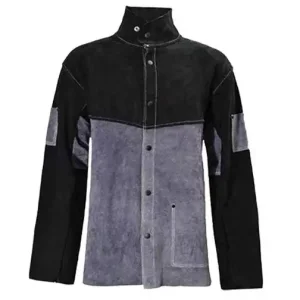
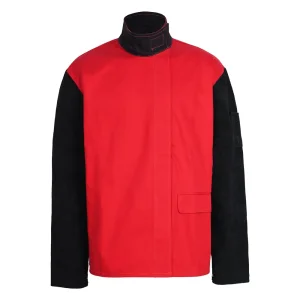
Traditional full-leather garments cause heat exhaustion during prolonged structural operations. Next-generation designs leverage 9 oz and 7 oz chemically treated flame-retardant (FR) cotton chassis for core ventilation, combined with select Grade-A cowhide split panels focused exclusively on critical high-spatter attack zones (shoulders, forearms, thigh fronts).
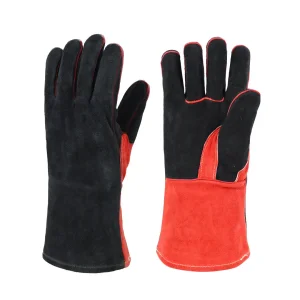
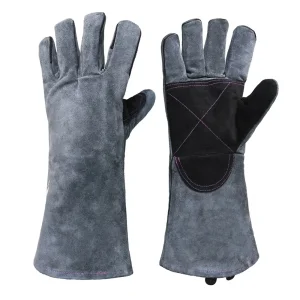
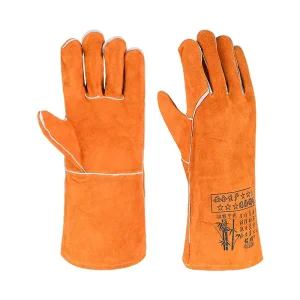
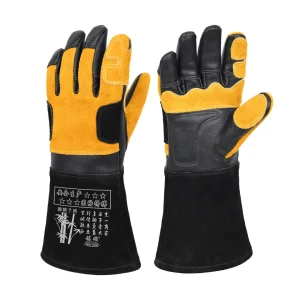
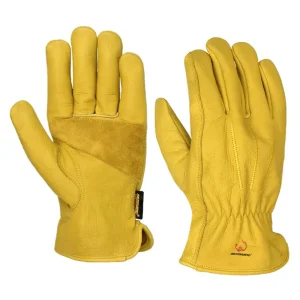
Hand fatigue remains the leading cause of glove discarding and workplace non-compliance. Our production floor implements 3D pre-curved fingering, keystone and winged thumbs, and ultra-supple top-grain goatskin tailored for precision TIG operations. The design retains tactile sensitivity below 0.7mm without sacrificing EN 388 puncture thresholds.
Global corporate supply directives demand strict elimination of hazardous chromium (VI) byproducts. We employ state-of-the-art closed-loop mineral tanning and vegetable re-tanning workflows, achieving compliance with EU REACH Regulation 1907/2006. This guarantees consistent dye penetration, odorless garments, and lower skin sensitization profiles.
Engineered to mitigate environment-specific hazards across heavy industry.
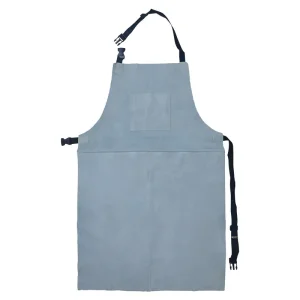
High-volume resistance spot welding, MIG robotic touch-ups, and laser cutting lines demand splash-proof split cowhide aprons and high-abrasion palm gloves that prevent lacerations from sharp sheet-metal edges.
Harsh maritime climates create unique challenges. Heavy structural pipe joint welding mandates moisture-resistant split-grain welding jackets, insulated Kevlar-stitched gloves, and spark-deflecting boot spats.
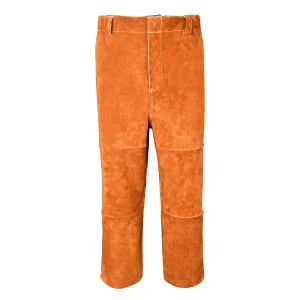
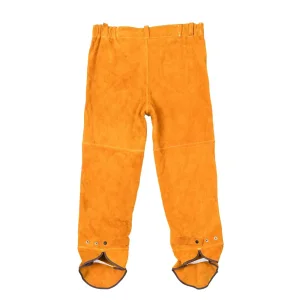
Confined-space bilge welding subjects personnel to intense radiant heat and multi-angle flux splatter. Comprehensive protection requires full-body leather trousers, overhead split hoods, and flame-retardant workwear.
Tungsten Inert Gas (TIG) root passes require maximum dexterous finger control. Operators depend on thin, puncture-resistant goatskin gloves with long leather gauntlets to protect wrists against conductive tank heat.
A systematic development trajectory detailing advancements in raw materials, automation, and compliance.
Implementation of AI-driven camera nesting on multi-axis laser cutters, improving hide utilization rates by 14% while reducing dimensional tolerances to ±0.5mm across bulk OEM runs.
Deployment of fluorocarbon-free hydrophobic and oleophobic surface treatments onto split cowhide fibers, shielding leather pores from molten slag adhesion and extending structural suppleness.
Integration of active microencapsulated PCM inner linings for welding jackets, buffering skin microclimates and absorbing excess body heat in high-ambient environments exceeding 40°C.
R&D into localized thermocouple and toxic fume detection sensor slots on welding hoods, connecting welders directly to industrial plant health monitoring platforms.
Comprehensive turnkey programs designed to optimize margin structures and eliminate logistical risks.
We convert buyer blueprints, sketches, or reference physical garments into market-ready commercial product lines. Our engineering department manages CAD grading, dimensional sizing (EU vs. US body archetypes), branded leather heat-stamping, woven neck badges, barcode labeling, and hangtag packaging tailored for national retail and industrial channels.
Defect minimization relies on verified operational checkpoints. Our factory operates a documented 4-step quality filter: 1) Raw hide density and chrome validation, 2) Precision die-cutting inspection, 3) Seam shear and DuPont™ Kevlar® stitch density audits (minimum 4-5 stitches per inch), and 4) Pre-shipment batch testing against burning behavior and mechanical abrasion.
With an expansive multi-story manufacturing facility in Pukang Industrial Park, Gaozhou, we support high-capacity monthly deliveries exceeding 500,000 glove units and thousands of protective leather garments. We support long-term framework contracts, scheduled split-container dispatches, and emergency regional buffer stocks for contracted key accounts.
Comprehensive answers addressing leather grades, international compliance, and OEM sample iteration.
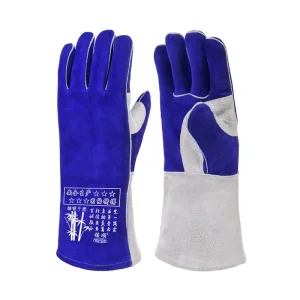
Heavy split cowhide (1.1mm to 1.3mm thickness) offers the ultimate heat barrier and molten metal deflection for stick and high-amperage MIG welding. For precision TIG, high-tensile top-grain goatskin is preferred for exceptional flexibility, enabling rapid filler wire feeding without heat transfer discomfort.
Conventional cotton or nylon threads instantly char, melt, and disintegrate when touched by flying sparks (600°C+), causing seam blowouts. We utilize 100% genuine DuPont™ Kevlar® para-aramid thread, which decomposes only above 450°C and maintains structural joint cohesion under thermal stress.
Yes. We offer flame-retardant embroidery, high-temp silicone thermal transfer, and blind leather debossing. All branding processes undergo flammability checks to guarantee that no surface embellishment compromises EN ISO 11611 or ASTM F1506 compliance standards.
Standard physical prototype generation requires 7 to 10 working days. Upon counter-sample sign-off and specification freezing, bulk manufacturing typically clears factory gates within 40 to 45 calendar days, supported by verified pre-shipment third-party inspection access.
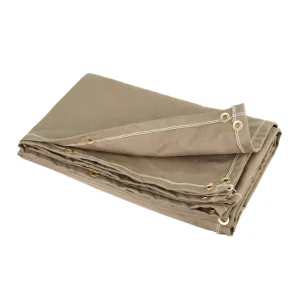
Comprehensive lower-body, full-torso, and specialty thermal shielding lines engineered for global distributors.