Explore precision-fabricated safety equipment built to withstand extreme molten spatter, radiant heat, and high-duty mechanical stress.
Procurement directors and health & safety compliance executives manage complex supplier portfolios. Addressing high risk and minimizing downtime demands end-to-end operational rigor.
Global contracts cannot absorb regulatory non-compliance. Welding PPE must clear both static and dynamic EN ISO 11611 (Class 1 & Class 2), EN 12477 Type A/B, and ANSI/ISEA 105 cut/puncture testing, supported by traceable test reports from accredited bodies like SATRA or TÜV.
Substandard hides and inconsistent flame-retardant baths trigger product failures on industrial lines. Enterprise buyers require lot-by-lot batch traceability covering hide origins, chromate-free tanning parameters, tear tensile strength, and LOI (Limiting Oxygen Index) fabric ratings.
Supply continuity drives procurement. Production run variances and container loading bottlenecks lead to warehouse stockouts. Direct manufacturing oversight ensures predictable lead times, bulk scalabilities reaching 500,000+ pairs monthly, and agile buffer-stock inventory models.
Operating beyond traditional OEM cut-and-sew operations. Our facility in Pukang Industrial Park integrates the entire value chain under unified ERP/MES control architectures.
By operating our own leather tanning and conditioning facilities, we eliminate hide thickness discrepancies, ensure precise chromium balance, and formulate specialized oils for superior thermal heat dispersal and oil/water repellency.
Automated nesting software and precision laser cutting heads guarantee millimeter-precise cutting of split leather and heavy FR cotton fabrics, minimizing raw material scrap and securing 100% seam alignment across garment components.
Every structural seam is sewn with genuine 3-ply to 5-ply Dupont™ Kevlar® thread, reinforced with cowhide welting to protect against burn-through caused by flying slag, high molten metal droplets, and edge-shearing abrasion.
Material testing occurs across raw delivery, mid-assembly stitch density tracking (8-10 stitches per inch), tension testing on snaps/hardware, and 100% manual needle-detector checks before export carton sealing.
Targeted PPE frameworks adapted to the thermal profiles, mechanical stresses, and ergonomic needs of specialized global industrial sectors.
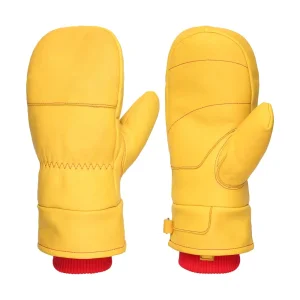
High-amperage SMAW and FCAW generate aggressive spark cascades. Our solution: Heavy 1.2–1.4mm premium split cowhide jackets, reinforced thigh trousers, and extended spats paired with Type A gloves that withstand continuous 350°C contact heat.
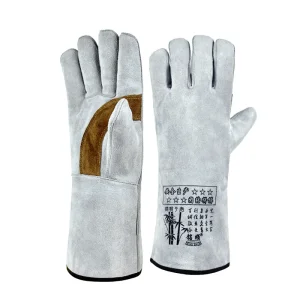
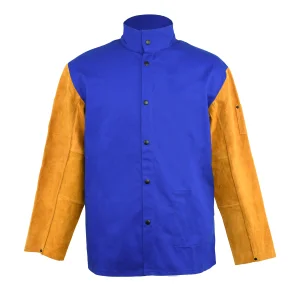
Balancing high dexterity with splash protection. Our hybrid FR cotton jackets with supple cowhide sleeves, combined with goatskin/cowhide MIG gloves (MS-829), deliver all-day ergonomic mobility for assembly-line tacking and spot-welding.
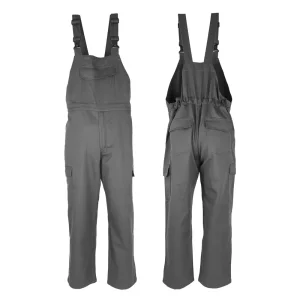
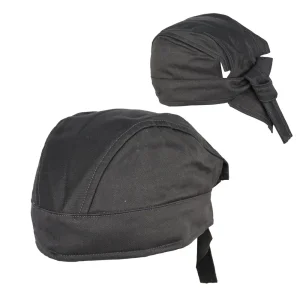
TIG welding demands micro-tactile feel and zero burn residue. We manufacture grain goatskin gloves engineered with seamless index finger designs, paired with breathable 9oz flame-retardant hoods and lightweight FR cotton bibs.
Environments requiring dual hazard mitigation: thermal welding spatter and combustible arc flash risks. Multi-norm protective garments combining certified AR/FR cotton (ASTM F1506 / NFPA 70E) with anti-static and oil-resistant finishes.
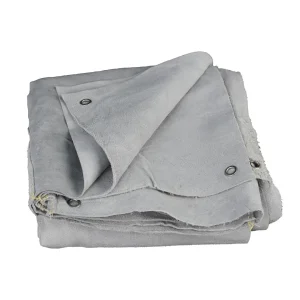
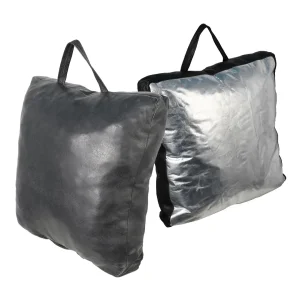
Extreme radiant exposure and metal-pour hazards. We engineer specialized aluminized-leather insulated pads, multi-layered welder knee cushions, and leather cable shrouds designed to extend industrial equipment lifespans.
Our ongoing R&D drives technical advancements across performance, worker ergonomics, and regulatory compliance.
R&D is advancing next-generation synthetic hybrid matrix polymers engineered to deliver the cut and spatter performance of cowhide at a 25% weight reduction, lowering operator thermal fatigue during prolonged shifts.
Leading environmental regulatory shifts. We are phasing out fluorinated water/oil repellents ahead of global bans, deploying plant-based organic tannins and PFC-free flame-retardant fabric finishing chemistry.
Prototyping sensor arrays inside inner jacket linings to monitor ambient core temperatures and worker pulse metrics, transmitting telemetry warnings via Industrial IoT (IIoT) protocols to help prevent heatstroke in confined spaces.
Helping brand partners pass customs audits, regional labor inspections, and third-party laboratory certifications with minimal friction.
Full technical file maintenance under PPE Regulation (EU) 2016/425 (Category II hazards). Complete Declaration of Conformity (DoC), EN ISO 11611:2015, EN ISO 11612:2015, and EN 388/12477 test certifications ready for importer validation.
Garments and gloves built to ANSI/ISEA 105:2024 performance levels for puncture, abrasion, and thermal heat degradation. Heavy flame-retardant fabric weaves aligned with ASTM F1506 and NFPA 2112 / 70E industrial standards.
Complete branding integration: heat-stamped leather emblems, high-visibility reflective trims, customized woven chest labels, branded barcoded retail polybags, and palletization designed around enterprise warehouse specifications.
Fully compliant with international labor frameworks. Our production plants undergo rigorous Sedex (SMETA) and amfori BSCI social audits, verifying fair working conditions, workplace safety, and zero child/forced labor throughout the upstream supply chain.
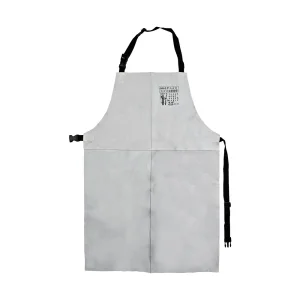
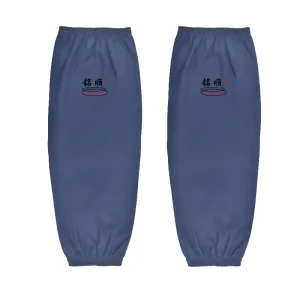
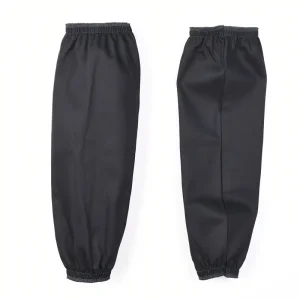
Explore heavy-duty protective accessories, leather sleeves, ergonomic hoods, and weld cushions engineered for professional fabricators.
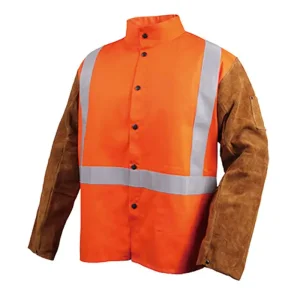
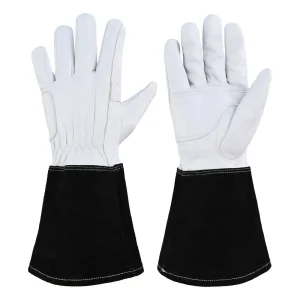
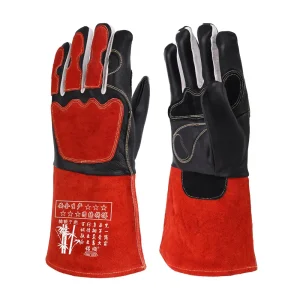
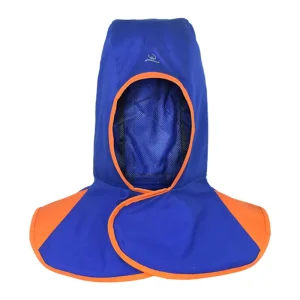
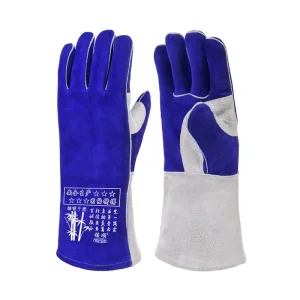
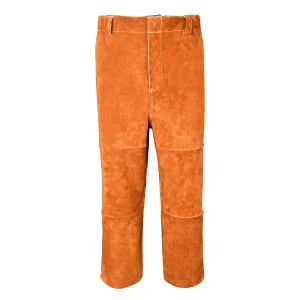
Key technical specifications, regulatory standards, and manufacturing workflows address buyers' primary sourcing considerations.
EN ISO 11611 classifies welding apparel based on protection against thermal risk and molten metal droplets. Class 1 protects against lower-level hazards (such as gas welding, TIG, MIG, micro-plasma welding with at least 15 drops of molten metal). Class 2 demands protection against higher-level hazards (such as MMAW, heavy FCAW, carbon arc gouging with at least 25 molten droplets and radiant heat index RHTI 24 ≥ 16s). Ming Shun conducts in-house molten drop simulation testing and third-party laboratory audits to classify every garment design accurately.
Most PPE suppliers purchase tanned hides from outside traders, which often leads to variations in hide thickness, oil content, color shades, and tensile tear limits between shipments. Ming Shun operates dedicated in-house beamhouse, tanning, and dyeing operations in Gaozhou. This provides total control over leather thickness calibration (1.1mm to 1.4mm), chrome absorption, thermal tolerance, and water/oil repellency, delivering consistency across container loads year after year.
For standard models carrying your customized branding labels, typical MOQs are 1,200 pairs for welding gloves and 300 to 500 units for specialized leather jackets or FR coveralls. Production lead time on initial OEM runs typically takes 40 to 50 days to allow for custom stamping tooling, pattern grading, and QA sign-off. Repeat container reorders are generally scheduled and dispatched within 30 to 35 days.
Our 7oz, 9oz, and 12oz industrial FR cotton weaves undergo chemical phosphorus-based molecular polymer grafting (comparable to Proban® and Pyrovatex® standards). The flame-retardant chemistry bonds directly within the cotton core structure, retaining certified flame-resistance properties for over 50 commercial launderings under ISO 15797 wash testing standards at 75°C.
Yes. OEM and ODM services are core to our manufacturing base. We regularly work from buyer-supplied tech packs, CAD sketches, or physical competitive benchmarks. Our engineering pattern shop can adjust armhole gussets, reinforce specific seam coordinates with split-leather backing, insert Kevlar® blast shielding, and apply customized woven labels, heat transfers, and debossed logos.