Explore heavy-duty welding garments, cowhide apparel, and certified workshop gear precision-engineered for commercial distributors and industrial contract requirements.
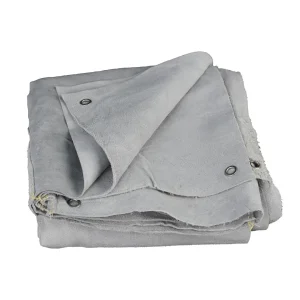
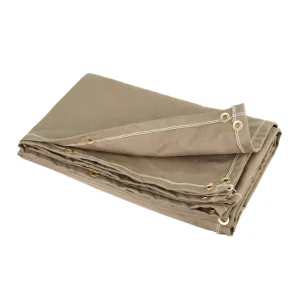
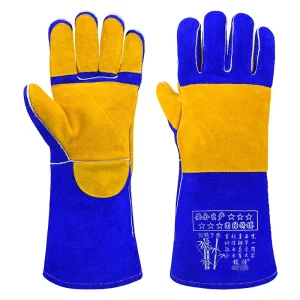
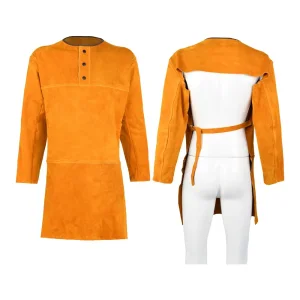
Analyzing vertical integration, supply chain stability, and raw material access that give Chinese manufacturing hubs a distinct competitive edge in welding apparel.
By controlling the split cowhide tanning and finishing facilities directly in Gaozhou, Guangdong, Chinese plants eliminate intermediary markups, mitigate dye-lot color deviations, and calibrate hide thickness precisely between 1.1mm and 1.4mm.
Modern Chinese contract manufacturing integrates computerized nesting algorithms with precision CNC laser cutters, significantly boosting raw leather yields and guaranteeing millimetric consistency across complex multi-panel safety garments.
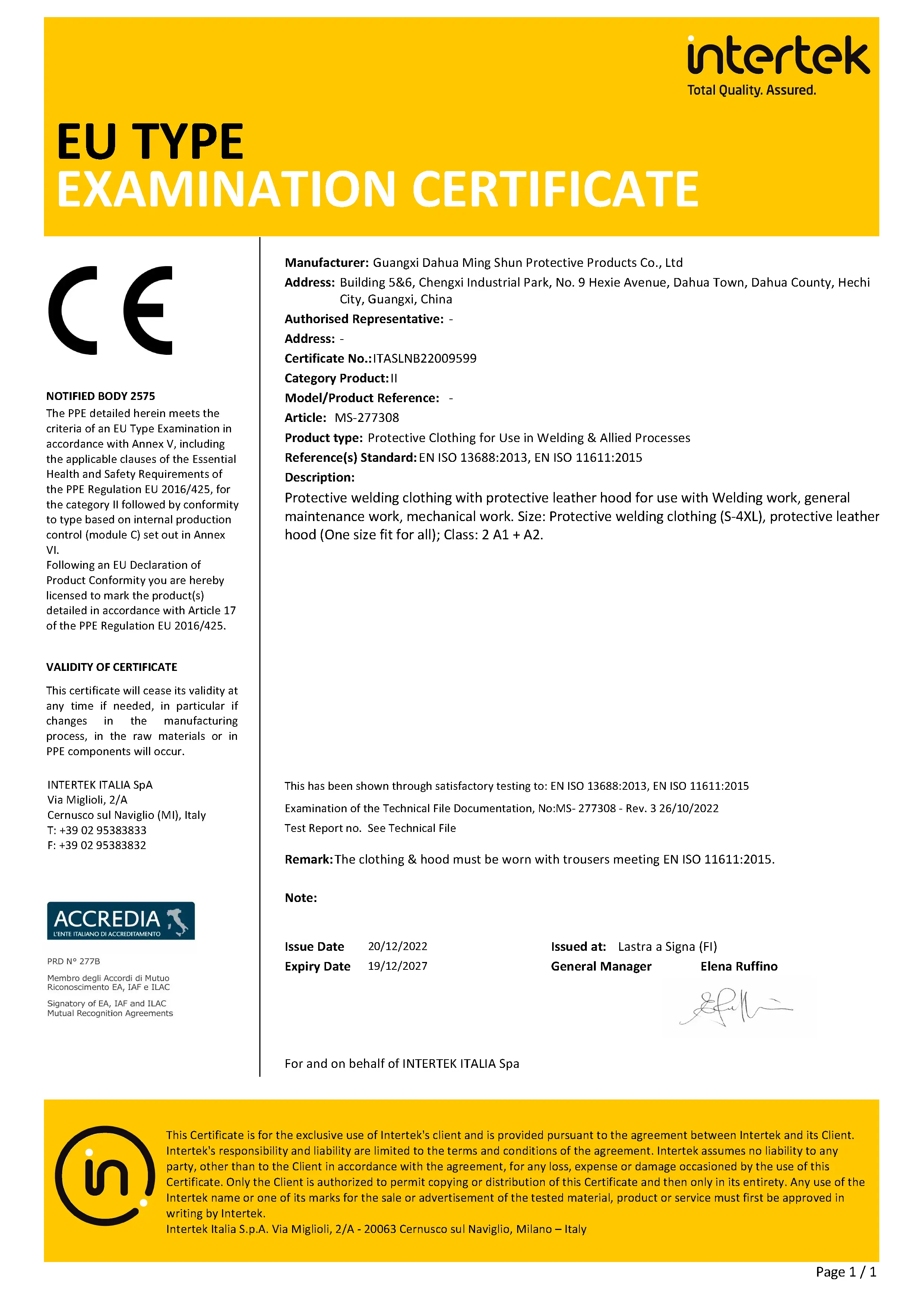
Certified production protocols ensure products meet EN ISO 11611 (Class 1 & 2) and ANSI/ISEA certifications. Fully documented batch traceability and REACH-compliant chemical treatments are standard for North American and European imports.
From heavy, rigid cowhide to engineered hybrid ergonomics: how functional textiles and heat mitigation research are redesigning welder workwear.
Traditional 100% cowhide jackets, while offering maximum spatter resilience, introduce severe worker fatigue and heat exhaustion in confined industrial environments. The global market is transitioning toward hybrid configurations. By deploying high-tensile, 9 oz or 11 oz breathable flame-resistant cotton across the back, torso, and underarm zones while reinforcing the chest, shoulders, and forearms with Grade-A split cowhide, safety apparel achieves an optimal balance between thermal spatter protection and operator mobility.
Strict European REACH regulations and North American corporate governance policies require complete transparency regarding heavy metal compounds, Chromium VI formation, and aromatic amines. Modernized Chinese facilities leverage bio-enzymatic hair removal, automated wastewater chromium recovery loops, and specialized chrome-free or vegetable-retanned leather baths to guarantee zero surface bloom and non-detectable free formaldehyde in export-ready weld wear.
In high-stakes utility operations, power generation, and subsea structural assembly, welders routinely operate near energized electrical gear. The current engineering frontier focuses on dual-certified protective clothing carrying both EN ISO 11611 (welding spatter) and IEC 61482-2 / NFPA 70E (Arc Flash PPE Category 2) compliance ratings, utilizing inherently flame-resistant aramid blenders and custom-shielded dielectric snaps.
Engineered protective designs configured for specific thermodynamic profiles, repetitive kinematic motions, and spatter densities across major sectors.
High-volume robotic and semi-automated MIG/MAG cells require ergonomic split leather sleeves and lightweight bib aprons that give robotic tenders full range of motion without snagging on fixtures or conveyors.
Naval shipyards demand full Class 2 EN ISO 11611 heavy-gauge cowhide jackets with stand-up mandarin collars lined with double-layered leather to protect against falling slag during overhead flux-cored arc welding.
Outdoor cross-country pipeline welders rely on water-resistant, oil-repellent leather aprons paired with full-body FR cotton coveralls featuring retroreflective accents compliant with ISO 20471 for low-light highway pipeline operations.
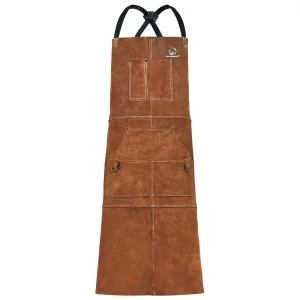
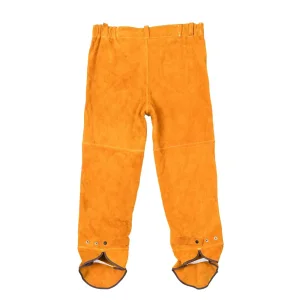
For high-altitude site welders, split leather trousers and heavy-duty aprons with self-balancing over-shoulder harness straps distribute gear weight off the cervical spine, preventing muscular fatigue on structural ironwork.
Precision aerospace and food-grade stainless tubing require non-linting, ultra-supple goatskin sleeves and specialized grain cowhide bibs that ensure zero particulate contamination and sensitive arc control.
Aluminized hybrid cowhide coats and bib aprons designed to reflect up to 95% of radiant heat while repelling heavy molten iron and copper splashes during recurring foundry pour cycles.
Essential quality checkpoints, testing metrics, and vendor evaluation criteria for safety directors and international contract procurement specialists.
Specify raw hide tolerances strictly between 1.2mm – 1.4mm. Sub-standard cuts below 1.0mm burn through prematurely during heavy stick arc applications, while cuts exceeding 1.6mm introduce restrictive stiffness.
Always demand 100% genuine continuous filament Para-Aramid (Kevlar®) 3-ply or 4-ply thread. Polyester or blended stitching burns, melts, and degrades upon contact with molten slag, causing catastrophic seam separation.
Corrosion-resistant brass or black-oxidized steel snap buttons must include dielectric outer insulation caps. Direct metal-to-skin contact creates conductive thermal paths that present burn hazards to operators.
Inspect critical junctions: pocket entries, strap anchors, and armhole unions must feature double-layer leather gussets backed by heavy-duty non-sparking copper rivets to absorb repetitive shop floor tension.
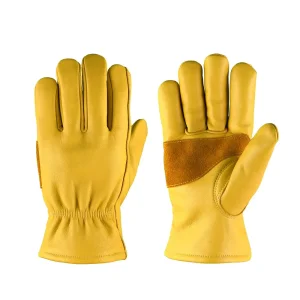
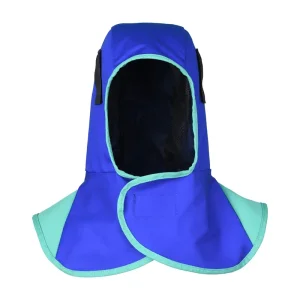
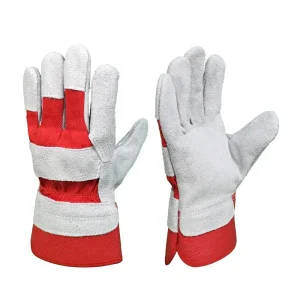
Explore our heavy-duty protective trousers, specialized TIG/Stick hand protection, high-visibility hybrid jackets, and FR headgear built for peak shop floor durability.
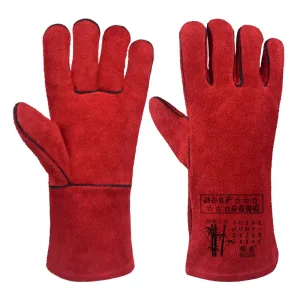
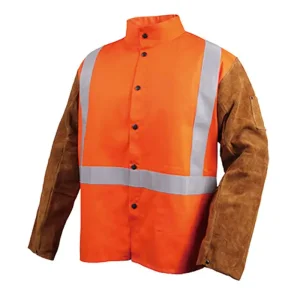
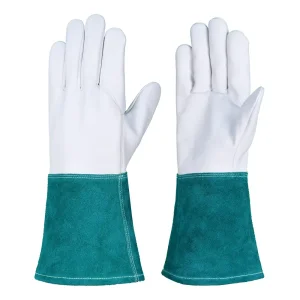
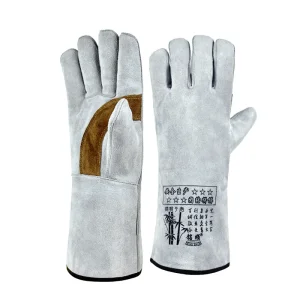
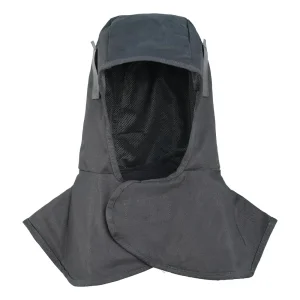
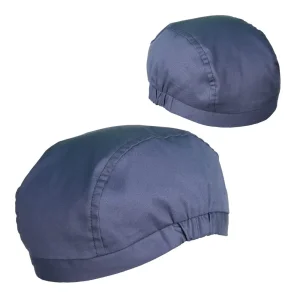
Comprehensive technical and commercial insights for import managers, distributors, and safety brand managers evaluating our manufacturing capabilities.
EN ISO 11611 defines two precise operational safety tiers:
Class 1: Engineered for lower-hazard welding techniques and working scenarios causing lower spatter volumes and radiant heat exposure (e.g., Gas welding, TIG, MIG, micro plasma welding). Requires resistance to at least 15 drops of molten metal and radiant heat transfer index RHTI 24 ≥ 7s.
Class 2: Designed for high-risk, heavy spatter welding techniques and operations (e.g., MMA manual metal arc stick welding with basic or cellulose electrodes, MAG with CO2 or mixed gas, flux-cored arc welding, and air arc gouging). Requires resistance to at least 25 drops of molten metal and radiant heat transfer index RHTI 24 ≥ 16s. Our premium MS-393 and MS-270 series cowhide lines are built to fulfill Class 2 criteria.
Because our corporate base in Gaozhou, Guangdong, integrates dedicated tannery facilities, we control hide sorting directly at the raw drum stage. Thickness is monitored across neck, belly, and butt cuts using digital ultrasonic micrometer gauges. In-house computer-controlled dyeing vats eliminate outsourced lot variance, guaranteeing pantone color fidelity (e.g., industrial gold, russet red, graphite slate) within delta-E < 1.0 from sample to full 40HQ container runs.
Our rapid prototyping engineering room produces tech-pack sample mockups in 5 to 7 business days. We provide comprehensive private-label customizations including high-definition laser debossing on leather pocket flaps, computerized heat transfers on FR cotton bibs, custom silicone tags, and retail-ready barcode hangtags. Typical bulk manufacturing lead time is 35 to 45 calendar days following pre-production sample signoff.
A heavy split leather welding apron (measuring 60x90cm or 60x105cm) averages 0.8kg to 1.3kg. When worn across an 8-hour manufacturing shift with tools loaded into the bib pockets, a single neck loop creates persistent strain on the cervical spine and neck muscles, accelerating fatigue and reducing productivity. Our ergonomic cross-back X-harness with self-balancing side releases distributes weight over the shoulder blades, improving ergonomics and compliance.
Our facility maintains ISO 9001:2015 quality management systems and complies with international workplace labor standards. We provide model-specific technical documentation folders (TCFs), CE certificates under Regulation (EU) 2016/425, and accredited third-party test reports from laboratories such as SGS, TÜV, and SATRA for abrasion, tear, flammability, and dimensional stability.