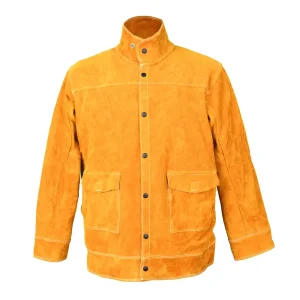
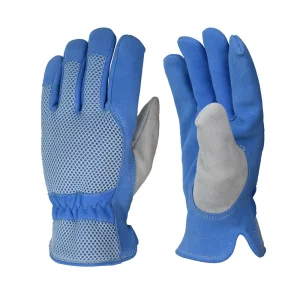
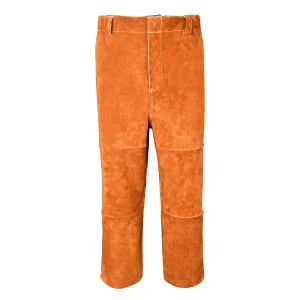
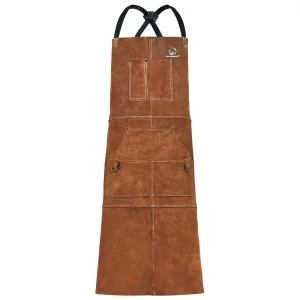
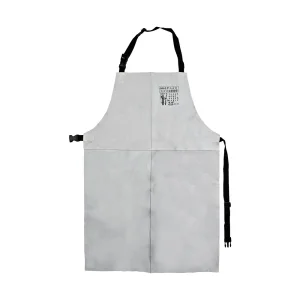
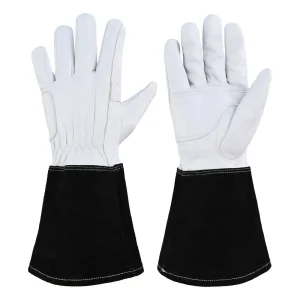
Precision-tailored split leather, grain cowhide, and heavy-duty flame-retardant industrial workwear built strictly to ISO, EN, and ANSI standards.
Enterprise data tracking our high-throughput leather manufacturing and FR fabrication matrix.
Analyzing enterprise requirements: ergonomic dynamics, heat abatement, and procurement cost optimization.
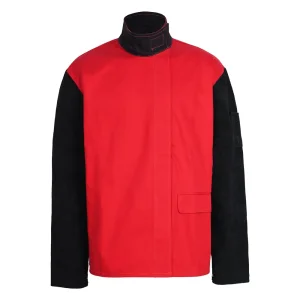
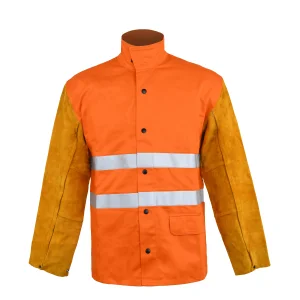
Traditional 100% full-leather welding jackets present significant mass and thermal retention challenges during multi-hour operational shifts. Enterprise procurement officers are actively transitioning toward Hybrid Leather-Sleeve Welding Jackets.
By engineering high-density 9 oz or 11 oz Flame-Retardant (FR) cotton across the core torso and deploying premium split cowhide across the arms and shoulders, our garments slash overall mass by 38% while sustaining uncompromised protection against high-angle molten slag.
Multi-national procurement teams require single-source manufacturing accountability. As a vertically integrated OEM manufacturer in Gaozhou, Guangdong, Guangdong Ming Shun Labour Protective Products Co., Ltd. controls raw hide procurement, custom chrome and chrome-free tanning, dyeing, and automated panel cutting.
This vertical integrity insulates industrial distributors from margin-eroding intermediary fees, stabilizes quality deviations, and ensures seamless logistics execution.
In heavy shipbuilding yards and offshore platform fabrications, jacket lifespan dictates ROI. Ming Shun applies high-tensile 3-ply Kevlar® aramid seam weltings to prevent thread incineration from spatter accumulation.
Reinforced dielectric snap closures and anodized splash flaps prevent electric conductivity risks, substantially elevating replacement cycle timelines and driving bottom-line equipment savings.
A rigorous comparative breakdown of substrate engineering in high-temperature industrial environments.
When engineering high-reliability protective equipment, selecting the leather cut is paramount. Split Cowhide Leather offers peak thermal heat conductivity deflection and mechanical puncture resistance. By integrating our proprietary deep-tanned oils, the split leather retains flexibility under repetitive temperature cycles without drying, stiffening, or premature embrittlement.
| Performance Characteristic | Side-Split Cowhide Sleeves | Shoulder-Split Cowhide | Grain Cowhide Leather | Treated FR Cotton Body |
|---|---|---|---|---|
| Spatter & Slag Penetration | Class 2 Superior (>40 Droplets) | Class 2 Standard (>25 Droplets) | Class 1 Resistant (>15 Droplets) | Class 1 Contact Only |
| Radiant Heat Transfer | RHTI24 ≥ 18.5 seconds | RHTI24 ≥ 16.0 seconds | RHTI24 ≥ 12.0 seconds | RHTI24 ≥ 8.5 seconds |
| Tear & Tensile Resistance | > 110 N (Warp/Weft) | > 95 N (Warp/Weft) | > 130 N (Omnidirectional) | > 65 N (Standard Weave) |
| Total Garment Weight Impact | Moderate (Focused on Arms) | Moderate-High | Elevated Overall Weight | Ultra-Low Thermal Strain |
| Compliance Rating | EN ISO 11611 Cl. 2 / ANSI 105 | EN ISO 11611 Cl. 1/2 | EN ISO 11611 Cl. 1 | EN ISO 11611 Cl. 1 (A1+A2) |
The seam design of an OEM leather-sleeve jacket represents the ultimate fault line under stress. Ming Shun utilizes parabolic welted seams sewn with flame-resistant meta-aramid/para-aramid fibers. Welting shields the stitching from molten spatter, preventing stitch severing under continuous flux-cored arc welding (FCAW) and submerged arc welding environments.
Pioneering the next era of industrial workwear with advanced functional materials and smart manufacturing.
Chrome-reduced tanning methodologies minimizing chromium salt residues. Integration of 9 oz to 12 oz breathable FR cotton bodies with reinforced split cowhide arms, satisfying zero chemical leach standards under REACH regulations.
Digital 3D biomechanical patterning designed for multi-axis arm rotation. Pre-curved arm ergonomics mitigate fatigue in overhead welding while avoiding fabric bunching at the elbow crutch where spatter often lodges.
Incorporating graphene nanosheet coatings into the cotton matrix to disperse radiant heat laterally across the body panel, slashing localized skin temperature spikes without requiring heavier base textiles.
Designing specialized heat-shielded internal conduits for body telemetry sensors (core temp, toxic gas detection, pulse tracking) for automated real-time worker safety monitoring in confined maritime compartments.
Complete traceability and certification dossiers for seamless importation across global jurisdictions.
Every hybrid jacket program targeted for the EU market complies with Regulation (EU) 2016/425. We provide Module B (EU type-examination) and Module C2/D production surveillance certifications. Garments undergo rigorous testing for flame spread (A1 + A2), radiant heat exposure, and impact of molten spatter.
For US and Canadian distributors, our dual-hazard designs comply with NFPA 2112 for flash-fire defense and ASTM F1506 for arc thermal performance. Leather sleeves are measured to prevent dielectric puncture, while metal snaps are thoroughly insulated behind heavy-duty dual-layer protective plackets.
We ensure zero Chromium VI formation through controlled vegetable and synthetic retanning processes. Products pass rigorous SVHC (Substances of Very High Concern) screening, Azo dye restrictions, and formaldehyde limits, assuring total consumer protection and regulatory clearance at international customs ports.
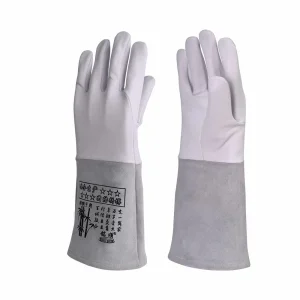
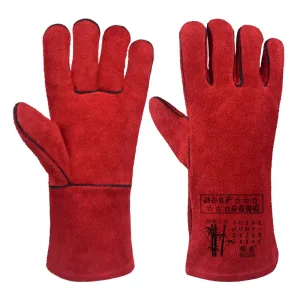
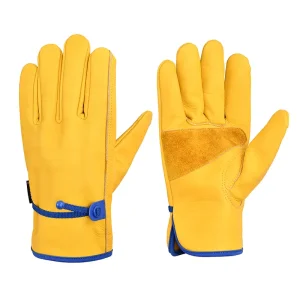
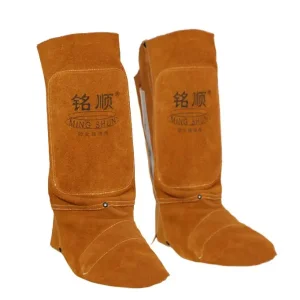
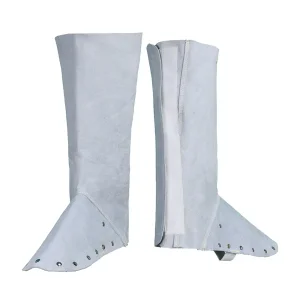
Explore protective split cowhide trousers, multi-hazard FR jackets, spats, and specialized high-dexterity hand gear.
In-depth technical answers for procurement teams, compliance managers, and global safety distributors.