
Engineered for extreme thermal barriers, arc-flash survivability, and mechanical abrasion resistance. Explore our benchmark OEM/ODM configurations manufactured in our vertically integrated facility.
Understanding regional compliance protocols, cross-border sourcing volatility, and the mandatory transition toward EN 12477 Class A/B and ANSI/ISEA 105 certified thermal barrier designs.
The tightening of OSHA 1910.138 guidelines alongside NFPA 70E and 2112 revisions has placed intense scrutiny on downstream flame-retardant PPE integrity. Procurement teams can no longer rely on unverified general leather cowhide; third-party tested ANSI/ISEA 105 flame degradation standards, contact heat performance (up to 500°F/260°C), and conductive heat resistance have become contractual minimums across energy and heavy fabrication conglomerates.
Under the EU PPE Regulation (EU) 2016/425, flame resistant gloves engineered for welding and intense thermal risks fall strictly under Category III—demanding not only initial Module B Type Examination testing, but ongoing Module C2 or Module D quality auditing. Suppliers must provide transparent full-traceability documentation for EN 12477 (Class A for heavy spatter and structural welding; Class B for high dexterity TIG configurations) and EN 407:2020 contact, convective, and radiant heat ratings.
While post-pandemic supply chain nearshoring was widely piloted across Eastern Europe and Central America, the systemic reality of leather processing infrastructure has cemented China's preeminence. Vertical tannery integration, chromium salt chemical management, access to diverse cowhide, goatskin, and pigskin supplies, and high-tenacity aramid thread clustering render Chinese OEM factories irreplaceable for scalable volume, margin stability, and rapid tech pack iterations.
| Performance Dimension | EN 12477 Type A (Heavy MIG/Stick) | EN 12477 Type B (High-Dexterity TIG) | ANSI/ISEA 105 Classification | Ming Shun In-House Test Spec |
|---|---|---|---|---|
| Burning Behavior (EN 407) | After-flame time ≤ 2s; After-glow ≤ 5s | After-flame time ≤ 3s; After-glow ≤ 5s | ASTM F1358 After-flame ≤ 2s | Zero Melt / Zero After-flame |
| Contact Heat Resistance | Threshold ≥ 100°C for ≥ 15s (Level 1) | Threshold ≥ 100°C for ≥ 15s (Level 1) | ASTM F1060 Level 2-4 (140°C - 260°C) | Verified Level 2 / Up to 250°C |
| Small Splashes of Molten Metal | ≥ 25 Droplets (Level 3) | ≥ 15 Droplets (Level 2) | Thermal Protection Performance (TPP) | > 35 Droplets Continuous Resistance |
| Abrasion Resistance (EN 388) | ≥ 500 Cycles (Level 2) | ≥ 100 Cycles (Level 1) | ASTM D3884 Weight Loss < 0.5g | Exceeds 2000 Cycles (Level 3+) |
| Dexterity Index (EN 420) | Test Pin Diameter ≤ 6.5 mm | Test Pin Diameter ≤ 4.0 mm | Modified Purdue Pegboard Test | Pin 3.5 mm High Tactility |
Flame resistant hand protection cannot be designed in an ideological vacuum. We calibrate leather thickness, palm split density, and aramid linings to combat distinct metallurgical hazards across modern industries.
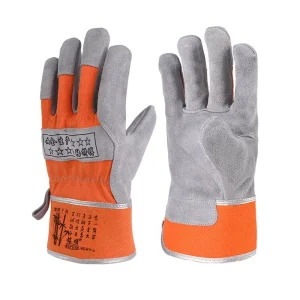
In offshore marine building and structural bridge welding, operators endure massive continuous radiant heat and violent flux-cored arc slag. Our MS-883 and MS-721bk configurations use 1.2–1.4mm heavyweight split cowhide, fleece-insulated inner thermal barriers, and reinforced Kevlar® welting that prevents hot spark ingress from shearing structural seams under grueling 8-hour welding cycles.
Maintenance technicians operating near automated robotic spot-welding cells face flash spatter combined with tight mechanical clearances. Here, bulk must be eliminated without compromising flame security. Premium grain goatskin gloves engineered with wrapped index fingers (MS-855N) provide zero-seam drag when adjusting robotic wire feeders, pneumatic nozzles, and automated clamping fixtures.
Hydrocarbon transport infrastructure requires multi-hazard gloves providing certified Arc-Flash Class 2 protection, inherent flame retardancy, and oil-repellent tanning treatments. In flare stacks, pipeline tie-ins, and valve overhauls, our FR-treated split leather hybrid systems prevent volatile oil soaking, shielding technicians from sudden flashfires and contact thermal conductances.
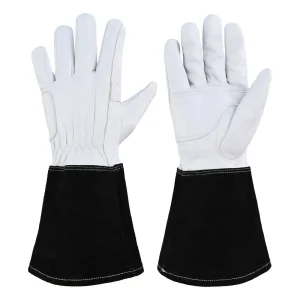
Exotic alloys such as Inconel, Titanium, and 316L stainless steel necessitate exceptionally pure, argon-shielded TIG processes where even micro-contaminants can destroy weld microstructure. Our ultra-supple goatskin series (MS-104U and MS-862) feature fatliquor-controlled leather that emits zero smoke or volatile oils upon high-frequency arc initiation, guaranteeing surgeon-level filler rod control.
For international brands, the critical vulnerability in leather glove procurement lies in decentralized sub-tier suppliers. When a cut-and-sew factory relies on third-party wet-blue leather markets, consistency collapses: tensile strength fluctuates, chromium content breaches RoHS/REACH thresholds, and leather stiffness changes with seasonal humidity.
Guangdong Ming Shun Labour Protective Products Co., Ltd. eliminates intermediate friction through absolute vertical ownership. Based in Pukang Industrial Park, Gaozhou—China’s global capital for leather protective apparel—we manage raw hide inspection, chemical splitting, proprietary non-flammable fatliquor immersion, precision dyeing, laser-guided cutting, and skilled aramid sewing across an integrated 1,000+ employee campus.
Direct access to global livestock hides and domestic premium splits maintains pricing stability despite macro commodity fluctuations.
Continuous testing ensures Hexavalent Chromium (Cr VI) remains undetectable (< 3 mg/kg) under stringent EN ISO 17075 mandates.
Traditional leather provides reliable bulk protection, but the future of industrial hand armor demands hybridized composite fibers, intelligent thermal telemetry, and carbon-neutral chemical processing.
Integrating 18-gauge seamless circular-knit liners combining Kevlar® (for cut and flame integrity) with continuous filament fiberglass and modacrylic fibers. This delivers Cut Level A5/E protection while reducing hand perspiration and hand fatigue by 34% compared to standard fleece.
Phasing in bio-circular, chrome-free tanning formulations using syntans and modified plant aldehydes. This process eliminates heavy metal runoff in local waterways, ensures 100% compliance with future zero-discharge EU chemicals directives, and enhances high-heat shrinkage resistance.
Micro-depositing flame-resistant fluorosilicone matrices directly onto palm leather wear zones. These micro-studs drastically increase wet and oily coefficient of friction (μ > 0.85) when clamping oily steel conduit, without hardening or blistering under 300°C contact exposure.
Embedding flexible, passive UHF RFID and thermocouple thread arrays inside glove gauntlets. Real-time factory telemetry flags heat degradation before leather crystallization occurs, preventing worker skin burns in high-risk automated smelting and robotic foundry operations.
Direct factory sourcing succeeds only when regulatory risks are systematically extinguished. We support international glove importers through full technical dossier provision, rigorous batch testing, and customized brand architecture.
We provide full technical documentation required by Notified Bodies (such as SATRA, SGS, and CTC) for Module B Type Examinations. This includes material bills of materials, chemical safety certifications (REACH SVHC declarations, Azo dye compliance, pH testing between 3.5 and 9.0), and factory production control audits.
Distributors can customize every square inch: heat-stamped leather palm logos, high-definition woven cuff labels, bilingual hangtags with required EN pictogram ratings, and barcode-scannable retail shelf boxes or polybags designed for automated industrial vending machines.
Before any container doors close, our QA team executes MIL-STD-105E (AQL 2.5/4.0) sampling inspections. Stitching tension, seam burst resistance, leather grammage, dimensional grading across XS to 3XL, and moisture content (strictly maintained under 14% to prevent in-transit maritime mold) are validated and signed off.
In-depth technical answers addressing split vs. grain leather choices, seam degradation prevention, MOQs, testing compliance, and factory audit mechanics.
EN 12477 classifies welding and flame-resistant gloves into two critical performance segments:
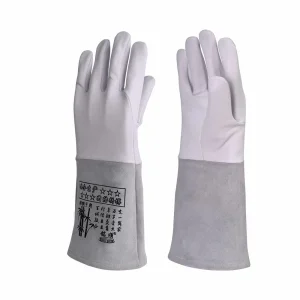
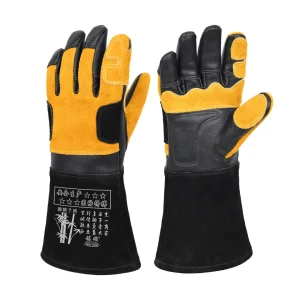
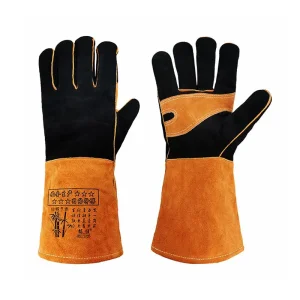
Type A (MIG/MMA/Heavy Arc): Engineered for elevated thermal protection, substantial radiant heat barrier capability, and maximum mechanical durability. These require thicker leather (typically 1.1mm to 1.4mm split cowhide), heavier cotton or fleece linings, and Kevlar® welted seams. They deliver higher contact heat ratings (Level 1 or 2) and withstand at least 25 droplets of molten spatter, at the natural expense of fine fingertip dexterity.
Type B (TIG/Precision Work): Engineered for high-dexterity tactile applications where the welder must handle thin filler rods (down to 1.0mm) without hand fatigue. These utilize supple, high-tensile grain goatskin or pigskin (0.7mm to 0.9mm thickness), unlined palms or lightweight cotton backings, and seamless index finger designs. While offering superior flexibility (passing Dexterity Test Level 4 or 5 with pin diameters under 4.0mm), they have lower resistance to molten spatter (minimum 15 droplets).
In standard industrial work gloves, seams are often sewn with polyester, nylon, or poly-cotton blends. Under welding spatter or radiant heat surges, nylon/polyester melts at approximately 210°C to 250°C, causing catastrophic seam rupture even if the leather remains intact. Once the seam unravels, the operator’s hand is directly exposed to arc radiation and molten droplets.
At Ming Shun, all our flame resistant gloves utilize 100% genuine continuous filament para-aramid (Kevlar®) thread (ranging from 30/3 to 40/4 ply depending on seam stress points). Kevlar® does not melt, drip, or support combustion in air, retaining structural tensile strength up to 450°C (842°F) and only beginning to slowly carbonize around 500°C. Furthermore, we insert protective leather welting inside the seam folds, shielding the Kevlar® itself from direct abrasion and spark shearing.
Color variation, thickness discrepancies, and stiffness differences are common issues when working with factories that buy random tanned leather batches from open markets. Ming Shun overcomes this through end-to-end tannery control at our Gaozhou facility:
1. Raw Hide Sorting: We strictly grade wet-blue hides by fiber density, fat wrinkle prevalence, and uniform substance prior to mechanical splitting.
2. Controlled Fatliquoring: We utilize synthetic lubricating oils that bond within the leather collagen matrix, ensuring that after repetitive hot drying cycles, the leather remains supple rather than turning brittle.
3. Spectrophotometer Color Matching: Computerized dye dispensing guarantees that our signature golden, red, pearl, or custom brand pantones match from batch 1 to batch 50.
4. Hydraulic Shaving: Digital gauge shaving machines ensure the leather thickness stays precisely within target tolerances (e.g., 1.2mm ± 0.05mm).
For custom OEM/ODM production (including branded leather embossing, custom woven labels, customized cuff borders, and specified packaging):
• Standard Glove Styles: Our baseline MOQ is typically 1,200 to 2,400 pairs per style/colorway, depending on whether specialized leather dyeing is required.
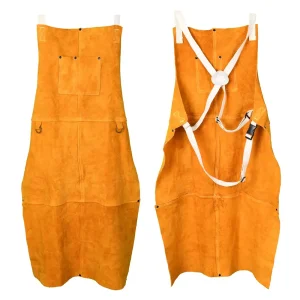
• Full Container Loads (20ft / 40ft HQ): Container orders offer optimal shipping rates and allow mixed assortments of welding gloves, jackets, aprons, spats, and blankets under a single private-label brand.
• Lead Times: Initial counter-samples are dispatched within 5 to 7 working days. Bulk production turnaround averages approximately 40 to 45 days following formal sample sign-off and deposit receipt.
Yes. Many of our multinational distributor clients require dual-compliant product architectures. Because our in-house lab benchmarks against both test standards, we build gloves that satisfy:
• Europe: CE Category II / Category III under EN ISO 21420 (General Requirements), EN 388:2016+A1:2018 (Mechanical Risks), and EN 12477:2001+A1:2005 (Welder Protection via EN 407 thermal matrices).
• North America: ANSI/ISEA 105-2020 testing protocols for Cut Resistance (ASTM F2992), Puncture Resistance (EN 388 probe), and Conductive Heat Resistance (ASTM F1060).
We work directly with certified laboratories such as Intertek, SGS, and TÜV to issue or transfer certified test reports under your brand name.
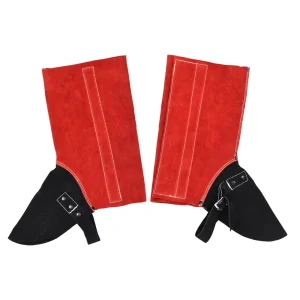
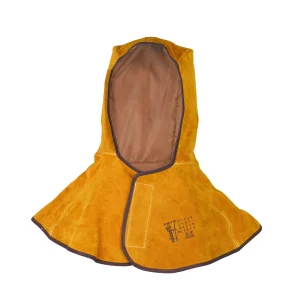
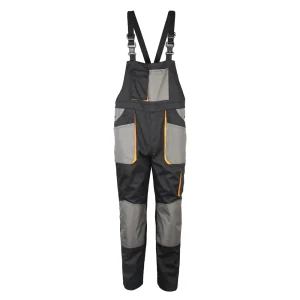
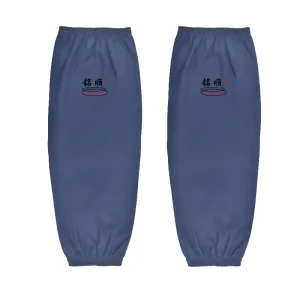
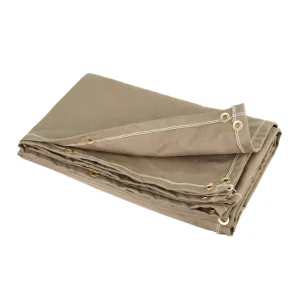
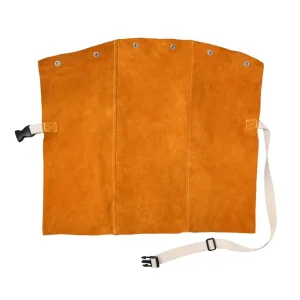
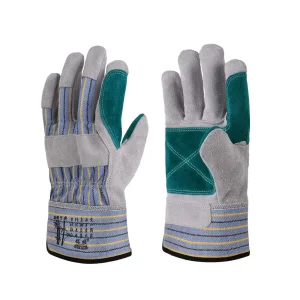
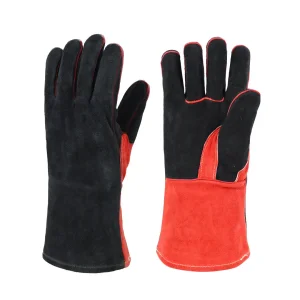
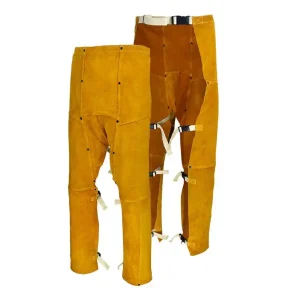
Full-body hot-work protection: Complementing our glove lineup with industrial fiberglass blankets, heavy split cowhide chaps, bibs, and ergonomic palm protection.
Partner directly with a 25-year certified manufacturer. Submit your tech pack, physical sample, or target testing parameters (EN 12477 Class A/B, ANSI/ISEA 105). Our technical team delivers pattern optimization, computerized prototype samples, and complete compliance dossiers within 7 business days.
