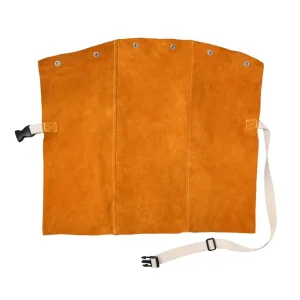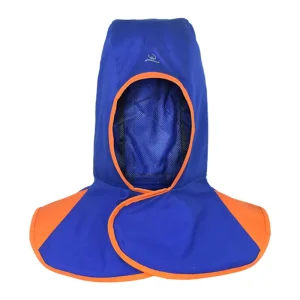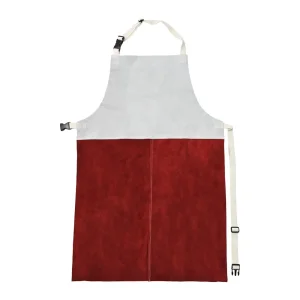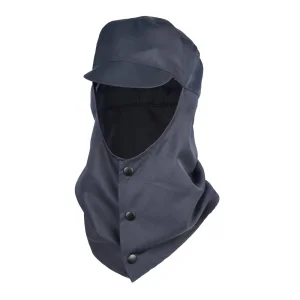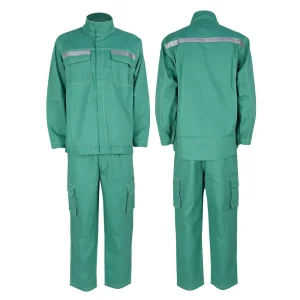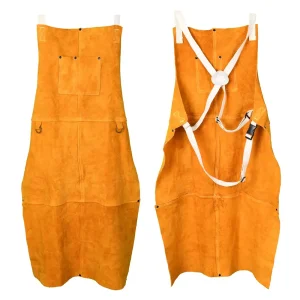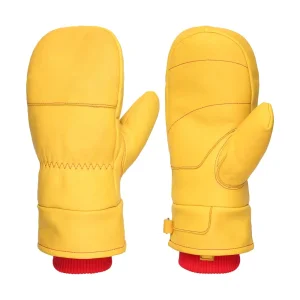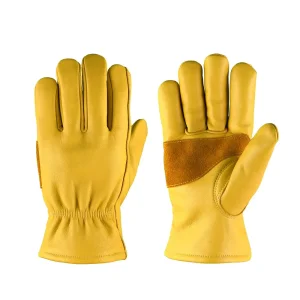
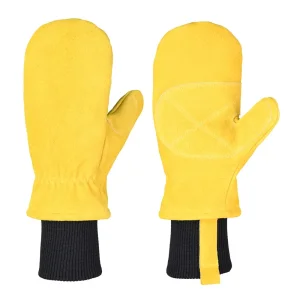
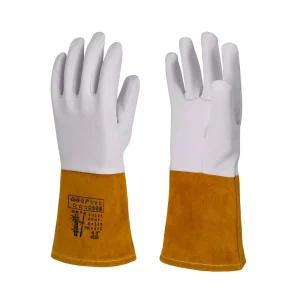
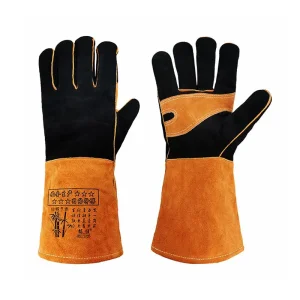
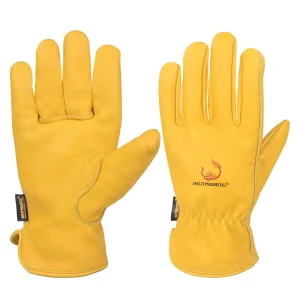
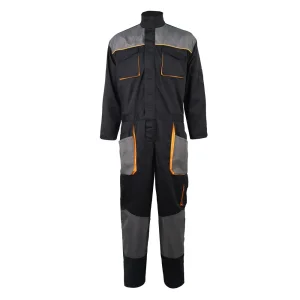
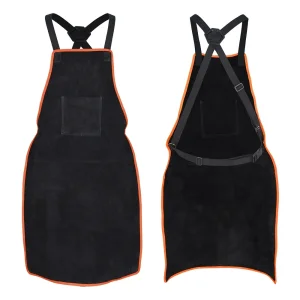
Explore our core product lines manufactured under strict international testing benchmarks for maximum spatter resistance, thermal insulation, and ergonomics.
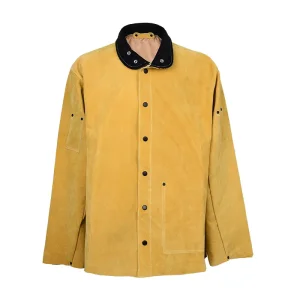
Macro analysis of industrial occupational hazards, standard shifts toward lightweight FR textiles, and lifecycle management in advanced fabrication.
Traditional heavy-split cowhide jackets, while offering high mechanical protection, impose substantial metabolic strain and thermal fatigue on operators in continuous cycles. Modern manufacturing trends favor 9 oz to 11 oz treated FR cotton body construction paired strategically with split cowhide or grain pigskin on high-trajectory spatter zones (arms and chest). This hybrid configuration decreases total garment weight by up to 42% while retaining Class 2 molten metal drop protection.
With the harmonization of ISO 11611:2015 and regional updates across ANSI/ISEA and CE Category II directives, safety managers now demand verifiable heat transfer index (HTI) ratings and limited flame spread after 50 industrial launderings. Cloth jackets manufactured from inherently flame-resistant (IFR) aramids or chemically bounded probanized twills are becoming baseline prerequisites for multinational procurement tenders.
The global welding apparel supply network requires vertical visibility. From yarn extrusion, chemical FR bath vat controls, to Kevlar® thread tensile benchmarks and rivet grounding integrity, industrial end-users reject uncertified batches. Direct OEM integration with factory-level quality systems ensures zero deviation across bulk shipments, reducing return authorization rates to sub-0.3%.
Engineered technical performance comparison across critical protective parameters, maintenance protocols, and economic durability.
| Protective Parameter | 100% Split Cowhide (MS-393) | 9 oz FR Cotton Cloth (MS-1260 Hybrid) | Heavy Treated Duck Canvas | Aramid/Modacrylic Blend |
|---|---|---|---|---|
| Spatter & Slag Shedding | Maximum (Resists deep burn-through) | High (Carbonizes, sheds micro-droplets) | Moderate (Surface charring risk) | Very High (Zero melting/dripping) |
| Weight / Operator Fatigue | Heavy (~1.6 - 2.1 kg) | Lightweight (~0.75 - 1.1 kg) | Medium (~1.2 - 1.4 kg) | Ultra-Light (~0.65 - 0.85 kg) |
| Breathability & Air Permeability | Near Zero (High heat traps) | Optimal (>45 L/m²/s) | Moderate (>20 L/m²/s) | High (>38 L/m²/s) |
| Laundering Longevity | Specialist leather conditioning | 50-100 cycles (EN ISO 11611 rated) | 25-30 standard washes | Inherent lifetime flame resistance |
| Best Application Vector | Heavy Arc Air Gouging / Overhead MIG | Assembly Line, Production MIG/TIG | General Metal Maintenance | Offshore Oil & Gas / Flash Fire Dual |
Operating from our integrated facility in Gaozhou, Guangdong, Guangdong Ming Shun Labour Protective Products delivers full control across raw fiber selection, tanning, precision cutting, and automated assembly.
Unlike trading middlemen relying on fluctuating third-party textiles, our internal dyehouse and finishing facilities control dye-lot consistency, PH values, and mechanical hand feel across millions of meters annually.
Utilizing digital plotters and automated laser cutting systems, our pattern master technicians minimize seam concentration along armpits and high-motion articulations, preventing seam ruptures during overhead welding postures.
From intake raw fabric roll inspections (tensile strength, tear resistance) to continuous line stitching monitoring with flame-retardant DuPont™ Kevlar® thread, every jacket is individually tagged and logged before master carton packout.
Engineered variations optimized for extreme temperature deltas, high-dexterity robotics co-working, and strict site safety codes.
Technicians monitoring automated spot welding require lightweight, antistatic FR cloth jackets that shield against occasional radiant flare without catching on chassis tooling or triggering robotic optical trip sensors.
Featuring reinforced high-tenacity split cowhide sleeves attached to ventilated 9 oz FR back panels. Breathable cloth backs prevent hyperthermia in confined hull compartments, while leather sleeves protect during heavy pipe welding.
Integrated with high-visibility 3M reflective tape configurations and internal harness access slits. Welders maintain 100% tie-off compliance at heights while remaining protected against heavy GMAW spatter.
Cost-effective, washable, standardized FR cloth jackets engineered to resist beginner arc strikes and torch mismanagement, providing institutional longevity for trade colleges and welding apprentice programs.
Anticipating the convergence of ergonomic performance, smart wearable sensor monitoring, and closed-loop environmental circularity.
Transitioning all outdoor welding cloth jacket fabrics to bio-based C0 durable water repellent (DWR) finishes, eliminating PFAS while retaining droplet runoff.
Incorporating graphene-infused cellulosic filaments into base cloth fabrics to deliver superior thermal dissipation, antistatic grounding, and enhanced slash protection.
Co-developing cloth jackets with pre-formed articulators, friction-damped shoulder padding, and routing for industrial upper-body passive lift assist harnesses.
Establishing commercial recycling programs for end-of-life FR cotton and aramid apparel to be re-shredded, chemically de-polymerized, and spun into raw industrial protective yarns.
Comprehensive technical and commercial clarification for safety brands, procurement directors, and importers.
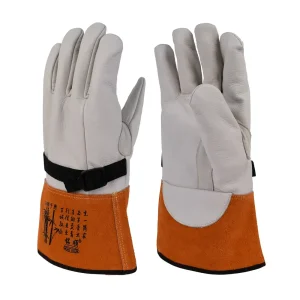
Full suite of secondary protective gear engineered to complete personal protective equipment ensembles across global fabrication environments.