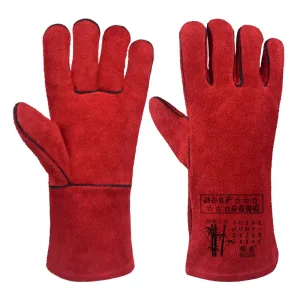
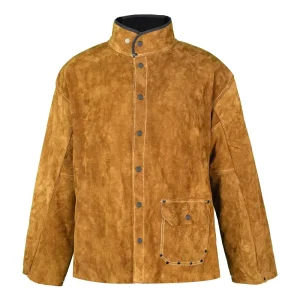
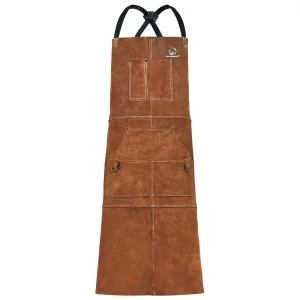
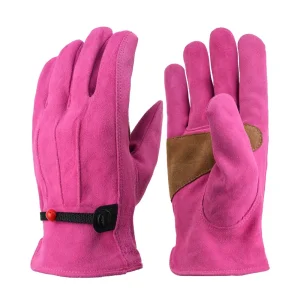
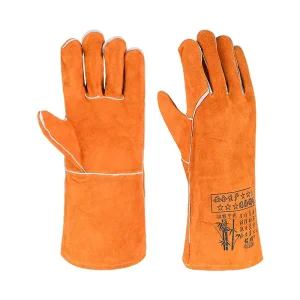
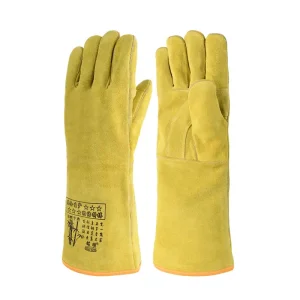
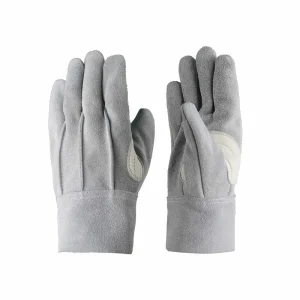
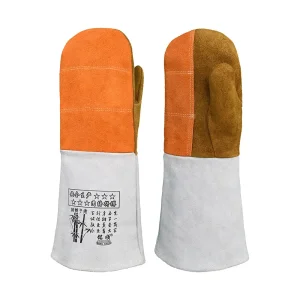
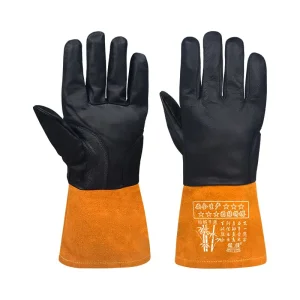
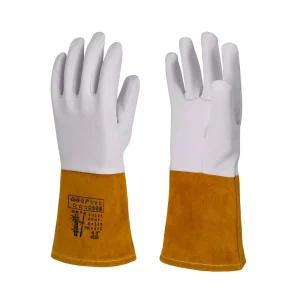
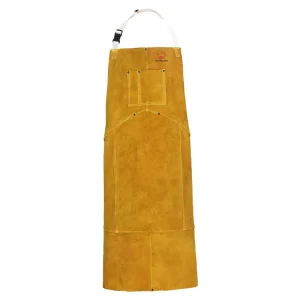
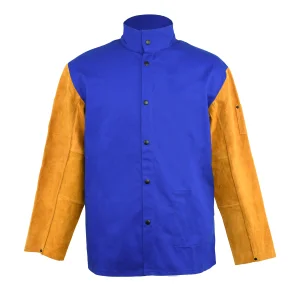
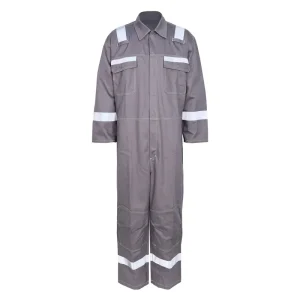
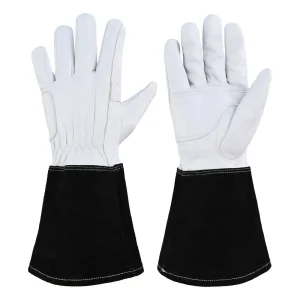
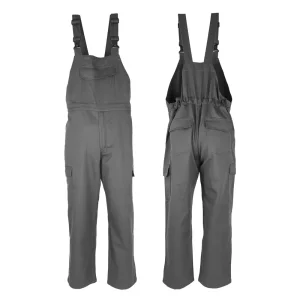
Direct factory production utilizing selected split cowhide, high-tensile goatskin, and flame-retardant composites tailored for high-amperage SMAW, GMAW, and GTAW applications.
Global procurement directors evaluate Arc Welding Gloves not solely on unit price, but on fiber stability, chrome content management, and dimensional stability across high-heat operations.
By executing chrome-tanning directly within our Gaozhou industrial facilities, we control hide pH, shrinkage temperature (exceeding 105°C), and chromium VI suppression below detectable limits (< 3 mg/kg), complying directly with EU REACH Annex XVII regulations.
Arc slag exposure deteriorates commercial polyester thread instantaneously. Ming Shun enforces 4-to-5 ply flame-resistant DuPont™ Kevlar® stitching with zero-drop welted seam engineering, fully shielding load-bearing edges from radiative burning.
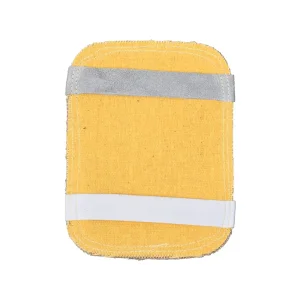
Heavy SMAW processes produce intense radiated convective flux. Our Type A Arc Welding configurations deploy a composite air-pocket lining combining flame-retardant brushed cotton with insulating aluminized foils to block both conductive and radiated heat surges.
International labor protection laws mandate verifiable classification under EN 12477:2001+A1:2005. Sourcing managers must align technical purchase orders with certified mechanical and thermal attributes.
| Performance Dimension | Test Standard | Type A (Heavy SMAW / GMAW / Carbon Arc) | Type B (Precision GTAW / Robotic Clean-up) |
|---|---|---|---|
| Abrasion Resistance | EN 388 (Cycles) | Level 2 (≥ 500 Cycles) - Split Leather High Density | Level 1 (≥ 100 Cycles) - Flexible Grain Leather |
| Blade Cut Resistance | EN 388 (Index) | Level 1 (≥ 1.2) Reinforced Palms Available | Level 1 (≥ 1.2) Goatskin / Deerskin Tactility |
| Tear Resistance | EN 388 (Newtons) | Level 2 (≥ 25N) High Interlacing Fibril Density | Level 1 (≥ 10N) Uncompromised Dexterity |
| Puncture Resistance | EN 388 (Newtons) | Level 2 (≥ 60N) Molten Spatter Shielding | Level 1 (≥ 20N) Tactile Filament Feeding |
| Burning Behavior | EN 407 (After Flame/Glow) | Level 3 (≤ 2s / ≤ 10s) Welted Kevlar® | Level 2 (≤ 5s / ≤ 25s) Seamless Finger Design |
| Contact Heat Resistance | EN 407 (100°C to 500°C) | Level 1 (100°C for ≥ 15s) / Opt. Level 2 (250°C) | Level 1 (100°C for ≥ 15s) Unlined Construction |
| Small Splashes of Molten Metal | EN 407 (Droplets) | Level 3 (≥ 25 Droplets) Heavy Split Gauntlets | Level 1 (≥ 15 Droplets) Extended Cuff Safety |
| Dexterity Rating | EN 420 (Smallest Pin Dia.) | Level 1 (≤ 11mm Pin Pickup) | Level 4 or 5 (≤ 6.5mm or ≤ 4mm Pin Pickup) |
Where customized welding gloves deploy: structural mechanics, high-temperature petrochemical installations, offshore pipeline fabrication, and mass manufacturing assembly.
Cellulosic and low-hydrogen downhill welding operations subject gloves to continuous slag wash and high ambient heat. Our MS-808 series incorporates extended 6-inch rigid cowhide gauntlets that prevent slag accumulation in sleeve cuffs, featuring full palm-welt reinforcers.
Marine environments combine intense ultraviolet arc exposure with high humidity. Ming Shun uses chrome-tanned leather treated with hydrophobic fat-liquors that prevent stiffening and salt-water drying stress, avoiding seam splitting on multi-layer ship hull assemblies.
Automated manufacturing demands high dexterity for manual spot welds and tack repairs. Goatskin and sheep-split hybrid gloves (such as our MS-874 / MS-M15 series) furnish Class 4 dexterity, allowing welders to grasp fine 0.8mm wire feeders without glove removal.
Engineered for comprehensive hot-work safety programs: Aluminized reflection, ergonomic TIG gloves, and hybrid flame-retardant safety garments built to international compliance baselines.
How next-generation welding hand protection is breaking trade barriers through bio-based sustainable tanning chemistry, 3D anatomical patterns, and digital quality auditing.
With global supply chains transitioning under strict ESG mandates, Ming Shun has pioneered chromium-free and vegetable-aldehyde blended tanning recipes. These achieve heat resistance matching traditional mineral tanning while reducing heavy-metal effluent in full compliance with ISO 14001 benchmarks.
Traditional flat glove layouts force continuous muscular tension when holding torches. Our modern tooling employs articulated 3D curved pre-curved gun-cut layouts with inset keystone thumbs, reducing hand fatigue by an estimated 32% during continuous shifts.
Eliminating variation in leather yield, Ming Shun incorporates computerized optical grading and CNC leather cutting stations. Stitch counts are calibrated rigidly at 8–10 stitches per inch using tension-controlled servo motors, avoiding premature thread tear-outs.
Objective, engineering-backed answers addressing international importation standards, leather behavior under extreme heat, minimum order metrics, and private labeling.
EN 12477 classifies gloves based on physical protection versus dexterity. Type A gloves require higher mechanical thresholds (Level 2 abrasion, Level 2 tear, Level 2 puncture under EN 388) and superior thermal resistance (Level 3 burning behavior and Level 3 molten spatter protection), making them essential for high-heat SMAW (stick), FCAW (flux-core), and heavy MIG operations. Type B prioritizes manual control (EN 420 dexterity Level 4 or higher) with lower mechanical resistance minimums (Level 1), constructed predominantly from flexible goatskin, sheepskin, or deerskin for precision TIG (GTAW) welding where tactile wire feed is paramount.
Leather shrinkage occurs when unbonded collagens dehydrate at temperatures exceeding 85°C. At Ming Shun, our in-house tanning treats raw split cowhide with specific thermal-resistant synthetic fat-liquors, raising shrinkage hydrothermal resistance above 105°C. For seams, we strictly specify Kevlar® aramid stitching integrated with full split-leather welting. Welting acts as a mechanical sacrificial barrier that physically covers the thread loops, blocking sparks and radiated heat from direct contact with the seam.
Yes. Ming Shun partners with internationally accredited test agencies including CTC, SATRA, and SGS to provide EU Type Examination Certificates (Module B) under PPE Regulation (EU) 2016/425, with corresponding Declarations of Conformity (DoC). For North American importers, comprehensive ANSI/ISEA 105 test reports covering thermal conduct, heat degradation, and ASTM F2992-15 cut resistance levels are supplied prior to order dispatch.
Our OEM services include customized palm configurations (reinforced split patches, padding), thumb profiles (straight, wing, keystone), leather grades (A, AB, BC split cowhide, top-grain goatskin), branded thermal transfer or heat debossing, customized woven wash tags, and retail hangcard packaging. Standard custom OEM project runs initiate at 1,200 to 2,400 pairs per SKU. Pre-production counter-samples are dispatched within 5–7 working days, with 40ft container production cycles completing reliably within 35–45 days.
Gaozhou accounts for a dominant share of global protective leather goods manufacturing. The region contains fully synchronized upstream supply networks: raw hide handling, automated tannery installations, specialized chemical dye manufacturers, flame-retardant lining textile mills, and hardware suppliers within a 30km radius. This geographic density enables Ming Shun to maintain cost efficiency, immediate raw material consistency, and superior risk management against supply chain shocks compared to fragmented overseas producers.